
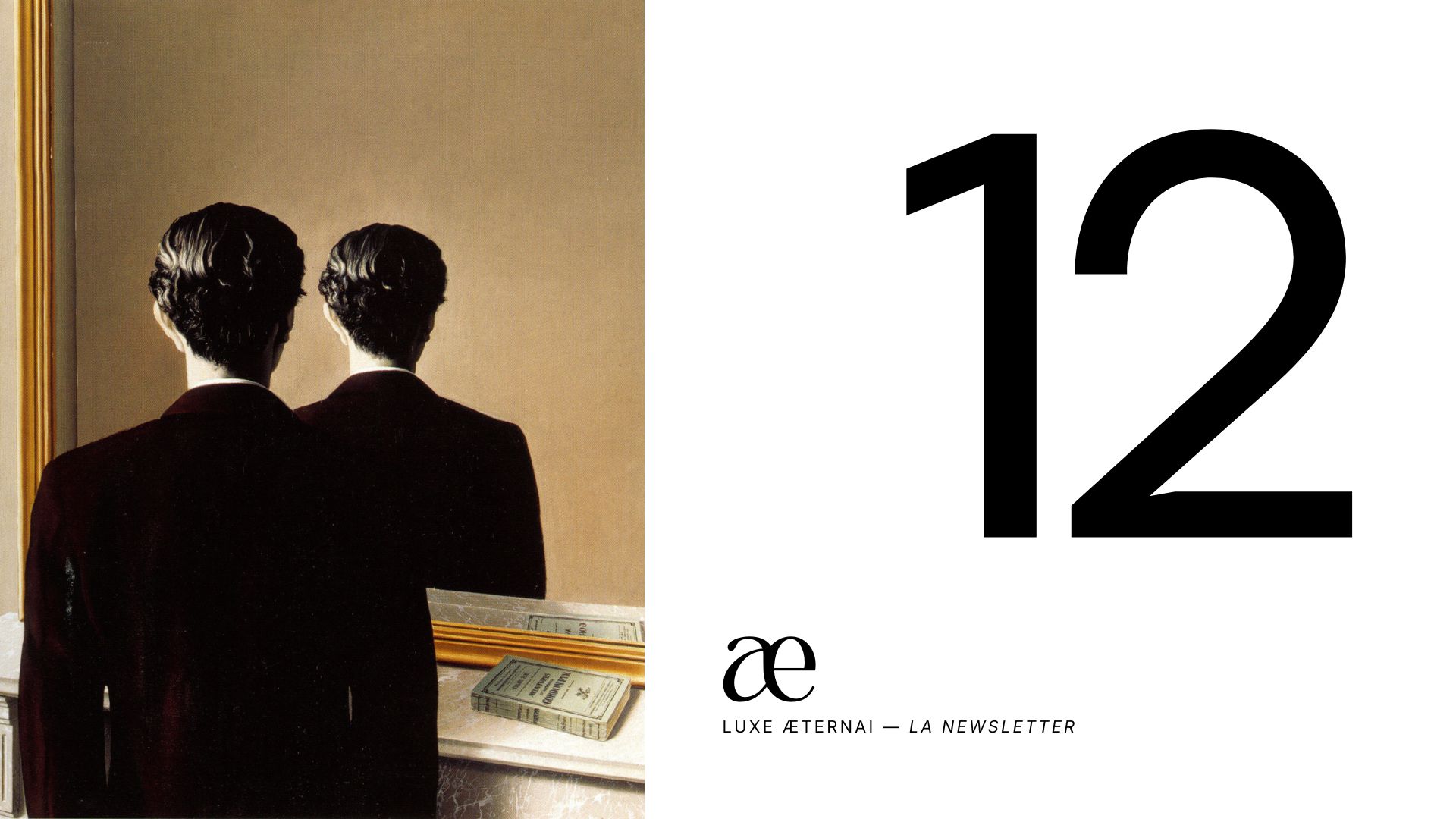
"The danger is not that machines will wake up. It is that we will forget the difference." — Ian Rogers, Tetragrammaton, May 6, 2026.
Ian Rogers served as LVMH's first Chief Digital Officer from September 2015 to November 2020. Previously head of Beats Music and lead on the launch of Apple Music, he has held since April 2026 the role of Chief Human Agency Officer at Ledger — a position created for him to steer the agentic transition. The sentence above opens his text published six days ago on Tetragrammaton, the editorial site of producer Rick Rubin. Six days later, in Paris, I read it again while watching a tailor stitch a canvas into a jacket by hand. That is where the title of this edition comes from.
This week, LUXE ÆTERNAI turns to the AI architecture doctrine that luxury houses must choose now. The middle-to-middle formula I invoke below was popularized by Balaji Srinivasan in a note published in June 2025; LVMH's former digital chief picks it up without crediting his source in the May 6 Tetragrammaton piece. I credit the full genealogy here. Not in a keynote, not in a press release: the doctrine plays out in the silent arbitration between three concurrent moves announced in seven days by the global enterprise AI ecosystem — the Anthropic + Blackstone + Hellman & Friedman + Goldman Sachs joint venture, with $1.5 billion in committed capital (May 4); the deepfake blowout around the Met Gala 2026, which exposes the fragility of brand visual provenance (May 5); and the Summer '26 release from Salesforce, which puts orchestrated AI agents into retail production starting next month (May 9). Details for each are below in WHAT'S MOVING. The common thread to register right now: none of the three announcements names a top-tier luxury house, and no Chief AI Officer appointment shows up in the window at LVMH, Kering, Richemont, Chanel, Hermès or Prada Group. At the same time, an AI-generated visual (entirely generated by artificial intelligence, with no real photograph involved) of the New York Costume Institute gala goes viral with several million views on X — Google Image surfaces it as linked to legitimate outlets (BBC, Vogue), giving a fake the visual signature of a référence media. And the BETA LUXURY column devotes its segment to a mature technology that the houses have still not adopted: the cryptographic signing of their official visuals.
I wrote in edition #9, late April, that AI must stay in the kitchen, not in the dining room. Three weeks later, the concrete question shifts. Once we accept that AI must remain behind the curtain, where exactly does that curtain run in this particular house, who holds it, and who audits, quarter after quarter, that it has not slid one meter forward? Edition #10 named that front on the agent side — the Pact of Legibility. This week, I name the front on the house side.
Luxury must choose an AI architecture doctrine. Three options on the table. End-to-end AI, which runs from creation to client conversation. Middle-to-middle AI (in the pipe, not at the ends), which works in the middle layer while both endpoints stay human. Or plain refusal, which is no longer a strategic option in any meaningful sense. I argue for the second. But I add what other outlets do not: the line between the three architectures is not static. It is actively held, quarter after quarter.
The Wrong Side and the Right Side. Do not read the title as an opposition. It is the phrase tailors and dressmakers have always used to describe the two faces of one piece of cloth. The right side is what the client sees, touches, wears. The wrong side is what holds the piece — the lining, the seam, the canvas. Albert Camus (French philosopher and writer, Nobel Prize for Literature 1957) chose it at twenty-three as the title of his first collection of essays: L'Envers et l'endroit, Charlot, 1937; current French edition Gallimard Folio Essais no. 41, 128 pages; in English, The Wrong Side and the Right Side, included in Camus's Lyrical and Critical Essays translated by Philip Thody, Knopf, 1968. Camus inscribes from the opening pages the book's founding dialectic: wrong side and right side are not opposed; they are the two faces of one and the same reality — and the writer's gesture, like the tailor's, consists in holding them together. This week's edition offers luxury a tailor's doctrine for its artificial intelligence. Lay the agentic interlining on the wrong side of the cloth. Industrialize it at scale. Never let it surface on the right side.
And what if the next strategic competence of a luxury leadership team in 2027 were not knowing how to integrate artificial intelligence, but knowing exactly where to hide it?
Welcome to LUXE ÆTERNAI: my weekly decoding of what AI agents change, or don't, for luxury houses. I am Mickaël Tsakiris. Twenty years in luxury, on both the house and agency sides — from Saint Laurent to LVMH, by way of Dior, Chanel and Hennessy. I work with houses and leaders who want to turn agentic AI into a competitive advantage while preserving their DNA. Enjoy the read!
Find every house, concept, source and the glossary of every edition in the LUXE ÆTERNAI knowledge base on Notion.
An AI architecture doctrine for luxury.
- Enterprise AI consolidates its industrial co-production model this week — engineers embedded with the client, not external consulting. The central joint venture of the moment commits an unprecedented sectoral capital pool (see WHAT'S MOVING). No top-tier luxury house named. No Chief AI Officer recruited.
- Ferrari publishes a record Q1 2026 without mentioning AI a single time in its filing with the US securities regulator. The SEC receives forty-seven pages on personalization; not one mention of the technology that could industrialize it. Narrative silence as an accounting asset.
- Met Gala 2026: a fashion deepfake goes viral at three million views; Google Image indexes it as if it came from the BBC. Luxury watches its own visuals become indistinguishable from the fake — without a technical system to sign what is real.
- Edition's proprietary concept: THE AGENTIC INTERLINING. A middle-to-middle doctrine applied to luxury — industrialize the pipe (back-office, supply chain, automated quality control), preserve the two human ends (upstream creation, downstream client relationship).
- BETA LUXURY — Content Provenance. The technology to cryptographically sign visuals is mature on the software side (Adobe Content Authenticity, Google SynthID, the open C2PA standard) and consolidating on the hardware side (Leica activated since 2023, Sony solid, Canon on hold, Nikon temporarily down since September 2025). No house has yet deployed it.
The agentic interlining is being woven in competitors' factories. Luxury watches the runway.
The industry that has the most to lose from the confusion between real and fake is the last to give itself a signature. The industry that industrializes its rarity at historic margins is the last to articulate the doctrine that protects that rarity in the agent era. The absence, for now, looks like waiting — but waiting always has an expiration date. The Excellence invariant holds only as long as the house can name what remains human within it. The agentic interlining is precisely the doctrine that lets it be named.
Three dates bring that expiration closer. On June 5, 2026, the major commerce platform used by several LVMH maisons and by Kering's brands flips to production: AI agents will be able to respond to clients from that date forward without human review, unless a brand-of-voice guardrail has been configured in advance. On July 19, 2026, the European Digital Product Passport applies to textile and electronic goods — the compliance plumbing is ready (Aura Blockchain Consortium, of which LVMH, Prada Group and Compagnie Financière Richemont have been members since 2021), but the doctrine for agent-side reading remains to be written. On August 2, 2026, Article 50 of the European AI Act requires systematic disclosure of the synthetic nature of any marketing content generated by machine. None of these three deadlines will wait for a top-tier luxury leadership team to take a position. Today's prevailing silence will, ninety days from now, translate into dated operational and regulatory shortfalls.
Three concurrent moves in seven days.
a The "McKinsey of AI" takes its retail positions before the houses — May 4, 2026
Anthropic, Blackstone, Hellman & Friedman and Goldman Sachs Asset Management announce on Monday, May 4, 2026 the formation of a standalone, AI-native entity with $1.5 billion in committed capital. Anthropic, Blackstone and H&F each contribute roughly $300 million, Goldman $150 million, with General Atlantic, Leonard Green, Apollo Global Management, GIC and Sequoia Capital in the consortium. The entity embeds Anthropic engineers directly into client workflows. Target sectors named in the official press release: healthcare, manufacturing, financial services, retail, real estate, infrastructure. Jon Gray, President of Blackstone, on the record: "We intend to build a scaled, world-class company to deploy Anthropic's incredible technology across a range of businesses in our portfolio and beyond."
Why it matters for luxury. The lead American fund in the venture manages more than $1.3 trillion in alternative assets, including premium retail and hospitality assets. Apollo Global Management holds, through its funds, brands that distribute luxury houses. The partners of luxury houses — their logistics providers, their tier-2 e-commerce platforms, their multi-brand distributors, their production subcontractors — will integrate Claude into their workflows before Louis Vuitton, Dior, Gucci, Hermès or Prada sign their own equivalent partnership. Competitive pressure does not build at the direct competitor. It builds at the competitor's supplier.
Sources: anthropic.com — official release, May 4, 2026; blackstone.com — press release, May 4, 2026; New York Times, May 4, 2026.
b Met Gala 2026: three million views for a deepfake, Google Image recycles the fake as a legitimate source — May 5–6, 2026
The Met Gala 2026 on Monday, May 4 generated a wave of unauthorized AI imagery in fashion social feeds of an intensity never seen before. Deadline documented on May 5 a viral post showing a Greek-statue-inspired silhouette attributed to Kendall Jenner — more than 3 million views on X, with no explicit AI-generation marker. Google Image Search returned these fakes as linked to the Met's coverage by legitimate outlets (BBC, Vogue), giving AI images the visual signature of référence media. Specialist editorial coverage — led by Deadline — documented in the following hours the contamination mechanic: a fake enters the Google index attached to référence media, and the barrier between official image and deepfake dissolves within hours.
Why it matters. The houses whose pieces were actually worn at the Met Gala — Dior, Valentino, Chanel, Givenchy, Versace — see their visual capital coexist in the same algorithmic feed as deepfakes, with no technical distinction. This is the first real-scale stress test of brand trust in the agentic era. And it is exactly the gap that BETA LUXURY documents further below.
Sources: Deadline, May 5, 2026; further coverage Wikipedia, official Met Gala 2026 page; sector voices on Vogue Business — Technology.
c Salesforce Summer '26: multi-agent orchestration in sandbox, production June 5 and 12 — May 9, 2026
The San Francisco-based enterprise software vendor published on May 9, 2026 the sandbox preview of the Summer '26 Release. The four most structuring building blocks for luxury are these. Multi-Agent Orchestration in Agentforce: several AI agents work as a coordinated team on the same client, with shared context across channels. Real-Time Offer Management: real-time offer personalization based on dynamic behavior. Storefront Next: AI-first enterprise-grade storefront. Process Compliance Navigator: real-time workflow monitoring, interception of actions non-compliant with a brand-of-voice charter. Production dates: weekends of June 5 and 12, 2026.
Why it matters. Saint Laurent, Bottega Veneta and several LVMH maisons already use the same vendor's Commerce Cloud platform (Forrester disclosures, 2025). On June 5, their instances flip automatically to Summer '26. In concrete terms: from that date forward, AI agents will be able to reply to their clients without human review, in existing flows — unless a guardrail system (the Process Compliance Navigator, included in the update) has been configured in advance to block out-of-brand replies. Four weeks to decide, house by house, what voice AI is allowed to take in their name.
Sources: salesforce.com — Summer '26 announcement; Salesforce Ben — release date; Synebo — enterprise implementation analysis.
The agentic interlining, or what luxury owes its two human ends.
Dimension: Brand sovereignty × Precision & anticipation.
A tailored jacket has three layers that you never see being assembled. On the outside, the noble fabric — virgin wool worsted, silk, cashmere, mohair. On the inside, the lining. And between them, the interlining — horsehair canvas, buckram, fusible or hand-stitched depending on the house. At Savile Row tailors who still practice full canvas (interlining stitched by hand, not fused), the canvas is laid in by needle, stitch by stitch, over two to three days for a jacket. It is what gives the jacket a line instead of a shape. It is what holds. No one ever sees it. You feel it in the fall of the shoulders, in the lapel roll, in the hollow of the back.
Artificial intelligence inside a luxury house must resemble an interlining. Industrialized at scale, laid in by hands that know where to stitch it, perfectly invisible to whoever wears the piece. This is what I call, in this edition, the agentic interlining. And it is, I believe, the least articulated AI architecture doctrine in luxury in 2026 — even as the groups industrializing other things are actively putting it at risk.
The central announcement of the week (detailed in What's moving) — the AI-fund-banks joint venture mentioned above — signals a rarely noted deployment model: engineers embedded with the client, in residence, rewriting operational flows around AI agents. This is no longer consulting; it is industrial co-production. And it is settling in everywhere — across Blackstone's portfolio companies, across retailers, across multi-brand distributors — but neither inside the top-tier houses, nor in this window. The shift from AI pilot to industrial production is taking shape without luxury, which watches the shift without naming its doctrine.
Meanwhile, LVMH's former digital chief publishes on May 6 on Tetragrammaton a text that says more than every consultant whitepaper of the window. The pivot sentence: "The future of work is not human or AI but human and AI. Businesses will soon have more agents on the job than humans, and the human role will be to orchestrate them. Humans are end-to-end. AI is middle-to-middle. The shape of the work changes while the responsibility does not."
Here is the grammar I believe is operative for luxury. The two ends of a house's work are, and must remain, human. The upstream end — the designer who draws, the patternmaker who builds, the artisan who stitches, the gem-setter who places, the perfumer who blends, the sommelier who opens. The downstream end — the advisor who recognizes the client, the host who anticipates, the salesperson who adjusts, the boutique director who decides to offer the espresso. Between them, a thousand invisible decisions — allocation, forecasting, translation, visual quality control, pre-merchandising, supplier scoring, fraud prevention, social moderation. That is the pipe. That is what must be industrialized. The luxury back-office is in the process of becoming its agentic playground. And that is what your competitors are industrializing this week with Anthropic, OpenAI or Salesforce — not you, not yet.
Richard Sennett (American sociologist, professor at the London School of Economics and at New York University, former President of the American Sociological Association) writes in The Craftsman (Yale University Press 2008; French translation Ce que sait la main, Albin Michel 2010, 405 pages, translation Pierre-Emmanuel Dauzat) that craft knowledge rests precisely on a dialogue between concrete practice and thought — the hand that thinks, the gesture that knows. This Sennettian intuition governs the cartography of the agentic interlining: what is downstream end for Hermès — the in-store conversation of the salesperson at 24 rue du Faubourg Saint-Honoré who knows her client book by heart — is probably already pipe for Sephora or Nordstrom. What is upstream end for Loro Piana — the selection of the cashmere yarn at Pellesina — is partly industrializable for an accessible ready-to-wear player. House-specific cartography is not a methodological convenience. It is the operational translation of a simple truth: the gesture has a place, and the place makes the gesture. No generic cartography. Your cartography, and that of your direct competitor.
First take. I believe that the responsibility of a luxury Chief Executive Officer in 2026 is to articulate a middle-to-middle doctrine that is written, dated and signed — an internal document that says precisely here are the six functions in our house entirely industrializable by AI within eighteen months; here are the four functions that remain wholly human and will not be delegated to a machine; here is the human committee that audits the boundary between the two on a quarterly basis. Written doctrine: yes, mandatory. Public doctrine: that is a separate trade-off, defensible either way. Today, shareholder pressure is rising but not yet acute on this point. Public pressure is even less so. But the two will converge before summer 2027. The house that has already written its doctrine, dated and signed, will then be free to choose its moment to publish it. The house that has not will discover that others are writing it on its behalf.
Second take. Keeping a human at a downstream end costs five to eight times more than a functionally equivalent AI agent. The question is not whether to do it. The question is whether that spend should be treated as a cost to compress or as a priceable asset. It is not a cost to optimize; it is an asset to price. The presence of a named, trained, recognized human at the last mile of the client relationship must be inscribed in the pricing of your house's premium segment. And explained publicly as such. If a client pays a four-thousand-euro commission on a fifteen-thousand-euro Birkin, part of that commission reflects the fact that the lady presenting it is not a Salesforce agent and never will be.
Third take. Doctrine does not hold by itself. The pipe has a natural slope that pushes it toward both ends. A greeting script suggested by AI slides toward an imposed script. A pre-written recommendation slides toward a recommendation sent without review. An opening brief for a campaign slides toward a final brief. Quarter after quarter, by ratchet effect, the middle gains two meters on each of the two ends. This is exactly what the Summer '26 Release industrializes on the commerce platform side. This is exactly what the engineers embedded with the retailers and hoteliers of the American fund's portfolio will identify as "high-value workflows" in their first client deliverables. Structural pressure exists — and it exists inside the house, not only in the public conversation. The doctrine is held by an audit, conducted by a human committee external to the executive committee that decides the AI budget arbitrations. A real audit, not an image committee.
Back to Camus, whose 1937 intuition frames this edition. The wrong side and the right side, he wrote, are the same thing. A luxury house's wrong side — its back-office, its supply chain, its well-placed AI agents — and its right side — its piece, its flagship, its gesture — are the same thing. The house that operationally separates the two faces without opposing them in its narrative will keep its credit. The house that fails to do that work will run a risk every tailor knows: without an interlining stitched on the wrong side, the jacket no longer holds. It hangs. That is exactly what happens to a house that lets AI settle in everywhere without deciding where it remains invisible: the line gets lost, the gesture blurs, the credit erodes — and the client feels it before the shareholders can measure it.
Sources: Ian Rogers, AI Will Be Many Things. But Never Human., Tetragrammaton, May 6, 2026 · Anthropic, enterprise AI joint-venture press release, May 4, 2026 · Salesforce, Summer '26 Release, May 11, 2026 · Richard Sennett, The Craftsman, Yale University Press 2008 / Ce que sait la main, Albin Michel 2010, translation Pierre-Emmanuel Dauzat, 405 pages · Albert Camus, The Wrong Side and the Right Side, 1937, Knopf English edition translated by Philip Thody (Lyrical and Critical Essays, 1968); French Gallimard Folio Essais no. 41, 128 pages.
Ferrari Q1 2026: Vigna, twenty percent of personalization, and the word no financial document contains.
Three record figures in the same release — and not a word for the technology that could industrialize it.
Monday, May 5, 2026, at 9 a.m. Maranello time, Ferrari publishes its first-quarter 2026 results. Benedetto Vigna, Chief Executive Officer since 2021, and Antonio Picca Piccon, Chief Financial Officer, open the earnings call with New York analysts. Q1 2026 net revenues: €1.848 billion, +3% on a reported basis, +6% at constant currency. EBITDA €722 million, 39% margin. EBIT margin (Earnings Before Interest and Taxes) 29.7%. Personalizations — bespoke pieces under the Tailor Made program, options on series vehicles, One-Off programs, the SF90 XX and Purosangue Handling Speciale families — at about 20% of net revenues. Order book extending to the end of 2027. From the May 5 Ferrari press release: "net revenues benefited from an enriched mix and continued demand for personalizations"; Vigna's closing verbatim: "With these results and an order book further extending towards the end of 2027, we confirm our 2026 guidance." The 20% personalizations figure is detailed by Antonio Picca Piccon, Chief Financial Officer, on the same day's earnings call.
Three record figures in the same release — and not a word, across its forty-seven pages, for the technology that could industrialize that personalization. It is that silence I find interesting this morning.
To understand the absence, you have to step out of Maranello and look at what the other premium carmakers are doing — and saying. Three operational axes, first-hand sources: official press sites of the manufacturers, earnings call transcripts, US securities regulator filings.
Audi — production and quality
On January 27, 2026, Audi publishes on its official press site a release titled "Audi scales up deployment of artificial intelligence in production." Five AI systems are explicitly named:
- Edge Cloud 4 Production (EC4P) — a cloud platform that has removed more than a thousand industrial computers and remotely operates around a hundred robots.
- Weld Splatter Detection — weld-splatter detection cameras, deployed at six sites.
- ProcessGuardAIn — real-time monitoring fusing historical data and sensors, entering series production in Q2 2026.
- AI-supported dryer operation and Production Reports — thermal control and operational reporting powered by AI.
Verbatim from Gerd Walker, Audi Board Member for Production and Logistics (official press release, January 27, 2026): "Artificial intelligence is a quantum leap for efficiency in our production. With our AI and digitalization roadmap, we are transforming our plants into smart factories where AI acts as a partner, providing our employees with tailored support."
In a three-way partnership with NVIDIA and Siemens, Audi has trained a computer-vision model to automate inspection of the five million welds performed each day across its plants, integrated into Siemens's Industrial AI Suite — line inference twenty-five times faster than before.
BMW — iFACTORY and Physical AI
BMW's whole production system carries a registered name: iFACTORY. Its AI building block is called AIQX (Artificial Intelligence Quality Next). Three figures to size the industrialization:
- Spartanburg, South Carolina — 60% of BMWs sold in the US, 1,500 vehicles a day. AIQX monitors half a million welds a day there.
- Regensburg (GenAI4Q pilot project, April 28, 2025) — 1,400 vehicles a day (X1 and X2), one vehicle every 57 seconds. A generative AI that "generates an individual inspection catalogue" for each vehicle (verbatim Rüdiger Römich, Test Floor and Finish, BMW Plant Regensburg).
- Leipzig (announced February 27, 2026, effective deployment spring 2026) — creation of a Center of Competence for Physical AI in Production, following a successful first pilot of humanoid robots at Spartanburg in December 2025.
Mercedes-Benz — MO360
The group has registered a trademark on its digital production ecosystem: MO360 (Mercedes-Benz Cars Operations 360), a family of connected applications that aggregate in real time the data of more than thirty Mercedes-Benz plants worldwide. Factory 56 in Sindelfingen is its showcase. The new paint shop under construction in Sindelfingen, with a $975 million investment, is designed from the outset with an intelligent digital twin.
Porsche — plants, R&D, configurator
- Zuffenhausen — smart factory transformation at €250 million.
- Leipzig — winner of the Automotive Lean Production Award in 2025.
- Cayenne Electric (commercialized early 2026) — development built on an AI digital twin, 20% development time saved, around 120 physical prototypes avoided.
- Car Configurator — running since 2021 on an AI Recommendation Engine with more than 270 machine-learning models. Verbatim from Axel Berger, Advanced Analytics & Smart Data Project Manager at Porsche: "We create a truly personalised online experience where we display relevant equipment options. No two users will receive the same recommendations."
Financial communication. And then there is Ferrari. Form 6-K filed with the US Securities and Exchange Commission on May 5, 2026. Run a search across the document. AI: zero. Artificial intelligence: zero. Machine learning: zero. Algorithm: zero. Configurator: zero. Atelier: zero. Tailor Made: one occurrence — in a capital-investment note — "higher investments in property, plant and equipment, reflecting our initiatives for the 'Tailor Made' program." Digital transformation: one occurrence, in the outlook section. That is it. Sources: Ferrari N.V. Form 6-K, May 5, 2026; earnings call transcripts reproduced by Seeking Alpha, CNBC, Investing.com.
There. Seven lines above, Picca Piccon was announcing twenty percent of net revenues in personalizations. Tailor Made appears only in capital investment, digital only under outlook spending, AI nowhere. Everything is said.
I do not know — no one outside Maranello does — whether Ferrari in fact uses AI systems for its configurator, for its client allocations or for its visual consistency validations. Ferrari does not say so. The silence is the doctrine here. While BMW trademarks its AIQX, while Audi names five systems and publishes a dedicated release, while Mercedes Group builds its plants as AI platforms and claims them as such, while Porsche tells the story of a vehicle through a digital twin — Ferrari publishes a record quarter on personalization and keeps quiet. The Ferrari Luce, unveiled in Rome on May 25, is the subject of more than sixty registered patents — the house knows how to write intellectual property when it wants to. On AI in its operations, it chooses a different communication regime.
Limited production: check. Thirty-nine margin:check. 2027 order book: check. Quiet tech to the letter: check.
Why is this doctrine worth watching for top-tier fashion houses? Signal: Ferrari demonstrates that premium financial communication can monetize a record quarter on personalization without naming the technology that enables it — and that the financial market validates the move. Friction: the doctrine imposes internal discipline. Top management must know precisely what it says, what it does not say, who decides. Verdict: quiet tech is not an absence; it is a narrative choice supported by a coherent execution. Vigna has done it. François-Henri Pinault (CEO Kering), Stefano Cantino (CEO Gucci), Bruno Pavlovsky (President of Fashion at Chanel), Pierre-Alexis Dumas (Artistic Director, Hermès), Patrizio Bertelli (Co-CEO Prada Group), Jonathan Anderson (Artistic Director, Dior) have not, in public, articulated it during the window.
The Compass. Three actionable questions which, put to the executive committee of any top-tier luxury house in the next ninety days, will be enough to diagnose the maturity of the doctrine:
1. Has your house written, dated and signed a middle-to-middle doctrine endorsed by top management — yes or no?
2. Does your next financial filing (Form 20-F, Universal Registration Document, integrated annual report) contain — or not — the phrase "artificial intelligence" — and is the answer aligned with your internal narrative doctrine?
3. Is the human committee that audits the AI-human boundary in your house on a quarterly basis external to the executive committee that decides AI budget trade-offs — yes or no?
The interlining holds. The piece has its line. No one, in the story, sees the interlining — and that is plainly deliberate.
Sources: Ferrari N.V., Form 6-K, filed with the SEC on May 5, 2026 · Q1 2026 earnings call transcripts on Seeking Alpha, CNBC, Investing.com · Audi MediaCenter, Audi scales up deployment of artificial intelligence in production, January 27, 2026 · NVIDIA Blog, Audi-NVIDIA-Siemens Industrial AI Suite partnership, May 20, 2025 · BMW Group, AIQX, official iFACTORY communication · BMW Group press T0449729EN, GenAI4Q Regensburg, April 28, 2025 · BMW Group press T0455864EN, Physical AI Leipzig, February 27, 2026 · Mercedes-Benz Group, Production Network & Factory 56 / MO360, official documentation · Porsche Newsroom, AI Recommendation Engine, 2021 · Porsche Newsroom, Leipzig wins Automotive Lean Production Award, 2025 · ArenaEV, How AI built the new Porsche Cayenne Electric, March 2026.
To a CEO of a top-tier luxury house.
I address it to a top-tier luxury Chief Executive Officer. I will not name the person; I will name the function.
In your house, in May 2026, is there a written, dated, signed document that states where the boundary runs between AI and human — yes or no?
If the answer is "soon," it is no. If the answer is "our AI ethics charter," it is no. If the answer is "here is the document," the audit has already begun.
A secondary variant, this time addressed to the director of a flagship store — Faubourg Saint-Honoré, Avenue Montaigne, New Bond Street, Via Monte Napoleone. The question takes this shape: "Tomorrow morning, at what hour exactly does artificial intelligence enter the conversation that your salespeople have with their most loyal client? Into stock-allocation scoring? Into the pre-drafting of the post-purchase thank-you note? Into the prediction of churn risk? Into the decision to offer the espresso?" The flagship director lives the middle-to-middle boundary in daily gestures, not in executive-committee slides. The answer says more about the actual practice of the doctrine than any charter signed by an ethics committee.
And a precise operating cost attached to the "soon" answer. A house that chooses to delay pays for the delay in concrete terms: three additional quarters of letting the middle perimeter drift, of watching the AI engineers deployed at its competitors internalize flows that its own tech function could claim if the doctrine were written, of letting pass the expression window in which a public stance would have surprised the market. "Soon," in May 2026, typically costs €15 to 20 million over eighteen months in lost editorial-option value. Not a line item visible on the income statement. An invisible line in the narrative. And the narrative, in luxury, is the income statement.
You might tell me the question is falsely binary, that no house has a document this precise in May 2026, that the maturity of the subject does not yet allow it. I think precisely that is what makes the question operative. The first house that replies "here is the document" turns the sector's general absence into an advantage. The second will be forced to react. The third will already have lost a tour. The subject does not wait until one is ready.
Image without memory: luxury's provenance crisis in the agentic era.
The cryptographic signing of visuals is mature… no house has deployed it.
The Met Gala 2026 on May 4 (recounted in What's moving above) did much more than viralize fashion deepfakes to several million views. It demonstrated, in a single evening, that none of the houses whose gowns were actually worn — Dior, Valentino, Chanel, Givenchy, Versace — has a technical mechanism for cryptographically distinguishing its official images from those the machine fabricates under its name. The word "deepfake" is too small for what is at stake here: a collapse of visual provenance. This gap is probably the largest blind spot of digital luxury in 2026. And the technology to close it has existed for eighteen months, in enterprise production, at a marginal cost.
The stake is not marketing; it is foundational. At the moment when generative AI enables a perfect, indistinguishable, viral reproduction, the cryptographic signature becomes the only technical trace of origin. Cryptographic signing is an authentication primitive; no communication posture replaces it. At the precise moment when fashion photography stops being proof of anything, signing cryptographically what is still proof becomes the single most strategic decision a house's leadership can take this year. And luxury has, to date, not taken one.
Four actors structure today's ecosystem for visual and video content signing. Adobe announced on October 28, 2025, at Adobe MAX, Adobe Content Authenticity for Enterprise, available today in production across GenStudio for Performance Marketing, Firefly Services and the Content Authenticity API (Application Programming Interface). Adobe automatically attaches Content Credentials to every generated asset, embedding a verifiable cryptographic manifest that identifies creator, date, tools used and successive modifications. Google generalized SynthID in 2024 and 2025 — a perceptibly invisible watermark embedded directly in pixel values by a neural network, resistant to JPEG compression, resizing and cropping. Natively integrated into Imagen 4, Veo 3 and Gemini. The open C2PA standard (Coalition for Content Provenance and Authenticity), co-founded in February 2021 by Adobe, Arm, BBC, Intel, Microsoft and Truepic — with Google, Meta and Sony joining the consortium afterwards — defines the technical format of the cryptographic manifest attached to each image, video, audio file. And the hardware chain: Leica M11-P (the first native C2PA camera since 2023), Sony A1 and A7R V (C2PA still-image firmware, 2024–2025 rollout), Canon R1 and R5 Mark II (C2PA firmware announced in July 2025, with Canon USA subsequently clarifying that the function is not active), Nikon Z6 III (firmware August 2025; Nikon Authenticity Service suspended in September 2025 following an authentication incident, certificates invalidated). The full chain exists — from capture to publication, every step can be signed.
Three prospective use cases for luxury houses on an eighteen-month horizon.
First case: the signed press kit. Chanel, Hermès or Dior cryptographically signs every image distributed to the international press ahead of a structuring event — runway show, Met Gala, fragrance launch, flagship opening. The C2PA manifest contains the official photographer, the time of capture, the retouching chain, the final signature from the maison's press attaché. An editor, journalist or agency can verify the image's authenticity in three seconds by running the file through the public checker at contentcredentials.org. Any unsigned deepfake stands out immediately as such — by difference. Marginal cost to the house: zero. Narrative cost to counterfeiters: high.
Second case: the signed campaign and the Verified Origin badge in social reading. Louis Vuitton signs its Spring-Summer 2027 visuals before publication. C2PA consortium members — Meta, Google, Microsoft — can technically display a Verified Origin badge next to maison posts on Instagram, Facebook, YouTube, Google Image, once they integrate the Content Credentials Checker. That is not yet the case by default, but the technical infrastructure is in place. The first house to publicly negotiate with Meta or Google the systematic display of this badge on its own channels achieves an act of structuring sectoral differentiation.
Third case: internal creative audit and traceable approval chain. A maison atelier signs its visual prototypes from creation onwards — designer's digital sketches, moodboards, options presented to the artistic director, successive approvals. The full creative approval chain becomes traceable. For groups that must prove to external auditors (ESG, governance, copyright, partnerships with art schools) the exact share of artificial intelligence in their creative process, C2PA traceability becomes a compliance asset.
Concrete demo to explore this week, if you want to test what exists: contentcredentials.org for the public checker, the Content Credentials Chrome extension for in-browser reading, and Adobe's enterprise documentation at business.adobe.com. The Leica M11-P, for those who want to see the signature operate from the moment of capture, has been available at Leica resellers since 2023.
On the software side, the chain is mature: C2PA standards operational, Adobe and Google in enterprise production. On the hardware side, it is consolidating: Sony solid on professional bodies, Canon on hold, Nikon temporarily down since the September 2025 incident. And no luxury house has, as of May 10, 2026, publicly disclosed a systematic deployment of this chain for its official campaigns. Here is a projection. In eighteen months — let us say autumn 2027 — a first top-tier luxury house will announce, in a brand trust communications stance, that its official campaigns are now 100% C2PA-signed, will integrate a verifiable badge on its own channels, and will publish public documentation of its chain. That house will deliver, in a single release, an exemplary middle-to-middle doctrine act — AI everywhere in the production chain (Firefly for retouching, Imagen or Veo for backdrops and variations), both ends signed (a named human photographer at capture, a named human artistic direction at publication). The campaign's interlining will be in place. The signature, this time, will be legible.
Sources: Adobe, Content Authenticity arrives for enterprises, business.adobe.com · Google DeepMind, SynthID, official documentation · Google, SynthID Detector, product announcement · C2PA, Coalition for Content Provenance and Authenticity, official standard · contentcredentials.org, Verify Media Authenticity, public checker · Sony A9 III, A1, A7R V — Content Credentials activation guide · Canon R1 and R5 Mark II — C2PA firmware, July 2025 · Nikon Z6 III — firmware 2.00, Nikon Authenticity Service, August 2025 · Adobe Help, Content Credentials overview, Leica M11-P integration.
Six readings to extend.
-
Ian Rogers, AI Will Be Many Things. But Never Human.
Tetragrammaton, May 6, 2026. The most precise text published in the window on enterprise AI architecture. Short, articulated, operationally usable. Read it first.
-
Anthropic, Blackstone, Hellman & Friedman, Goldman Sachs: Building a new enterprise AI services company
anthropic.com, May 4, 2026. The joint venture's official release. Read it for the exact list of target sectors and the governance structure.
-
Salesforce, Summer '26 Product Release Announcement
salesforce.com, May 11, 2026. The enterprise documentation of multi-agent orchestration and the Process Compliance Navigator. Read it ahead of June 5.
-
Adobe, Content authenticity arrives for enterprises
business.adobe.com. The enterprise documentation of Content Authenticity for Enterprise. Read it ahead of any decision on the signed press kit.
-
Balaji Srinivasan, Network School: AI middle-to-middle, humans end-to-end
x.com — @balajis, June 29, 2025. The originating note for the concept that the former LVMH CDO picks up in his Tetragrammaton piece without citing his source. Read it for the full genealogy — and to grasp that the doctrine was not born in luxury; it is for luxury to fetch it from tech and transform it into a sectoral doctrine.
-
Richard Sennett, The Craftsman
Yale University Press, 2008. The book that underwrites the entire grammar of the agentic interlining. Read it after this week's decoding to understand why the artisan's gesture is not industrializable like a data flow — and why the cartography of the two human ends must be house-specific, not generic.
Edition #13 — what's next.
Next week, Compagnie Financière Richemont publishes its FY2026 annual results on May 22, after six months of near-complete silence on AI. The Ferrari Luce will be unveiled in Rome on May 25, with more than a hundred configurations already turned down. Salesforce flips Summer '26 to production on the weekends of June 5 and 12. And on June 22, Cannes Lions 2026 opens, with the Luxury & Lifestyle Lions jury yet to be announced — the window for qualifying maison AI-augmented campaigns closes by then. The agentic interlining will, at each of these four rendezvous, have the chance to be named — or to keep on not being.
— Mickaël Tsakiris
Paris, Thursday, May 14, 2026
Luxe oblige!