
TL;DR
- The thesis: a luxury house used to be defined by what it gave to be seen. It is now also defined by what it gives to be read. The Pact of Legibility is the arbitration between what you encode for agents and what you leave in silence.
- LVMH AGM, April 23: Bernard Arnault defers his succession by "seven or eight years" and brings his five children to the lectern for the first time at a group AGM. In parallel, the AI for All program rolls out AI training to LVMH's 211,000 employees, alongside a Responsible AI Charter.
- Adobe Summit, April 20: Loni Stark, VP Strategy & Product, makes the industrial diagnosis: "A new intermediary has imposed itself between brands and their customers, and unlike the previous ones, it has the capacity to reason." Adobe announces LLM Optimizer, Brand Concierge, and quantifies the shift: +269% AI-driven traffic to U.S. retail sites year over year as of March 2026.
- Yann LeCun raises $1 billion for AMI Labs (Paris, March 10, 2026). His thesis: an LLM cannot infer what was never coded. Direct implication for luxury: unverbalized rarity, the artisanal gesture, and strategic silence are, by construction, invisible to agents.
- L'Oréal Q1 2026 posts adjusted like-for-like growth of +6.7% and confirms the extension of its AI partnership with NVIDIA. EssilorLuxottica chains a third double-digit quarter on the back of Ray-Ban Meta. The winners encode in the kitchen.
- EU AI Act Article 50 (the European regulation on artificial intelligence) becomes enforceable on August 2, 2026. With 96 days to go, the draft Code of Practice structures obligations into three tiers, and the houses' silence on their preparedness continues.
PARADOX OF THE WEEK
"Visible no longer means legible. And the house that does not master the difference will be read by default, not by choice."
David C. Edelman, Senior Lecturer at Harvard Business School, executive advisor and a Think with Google contributor, writes this month: "the brand must be conceived as the sum of the signals that make it identifiable as a solution". Recast for agentic luxury: the brand is now read by an intermediary that reasons, and that reader is not human. What it knows about the house does not depend on what the house has shown, it depends on what the house has explicitly coded for it. The more the house codes, the more legible it becomes. The more legible it becomes, the more it lends itself to comparison. The more it lends itself to comparison, the more it loses what made it rare.
Roland Barthes put it another way, in a different era but with a lucidity that takes on new meaning: in Système de la Mode (1967), he distinguished the written garment from the real garment, the first manufactured by fashion media and made of signs, the second living, irreducible to the sentence. There have always been two distinct houses: the one that writes itself in the press, and the one that transmits itself through gesture. What is new in 2026 is that a third text now slips in between. The house as it is read by an agent. Neither seen, nor transmitted, now coded.
The agentic shift confronts luxury with a structural dilemma. Encoding is à condition of existence in the new architecture of desire: without legible signals, the agent recommends a competitor. But over-encoding depreciates the sign itself: if everything is coded, nothing is rare. To encode is to surrender the sign to comparison. What was signal becomes information.
Luxury is not afraid of agents. It knows that any information offered is a sign consumed. It also knows that any information hidden is a sign protected. The Pact of Legibility is the arbitration between the two, and the substance of this edition is precisely the cartography of that arbitration, signal by signal, house by house.
WHAT'S MOVING
L'Oréal Accelerates on Agentic Chemistry
Tuesday, April 22, the world's number-one beauty group reports Q1 2026 revenue of €12.15 billion, up 3.6% on a reported basis and +6.7% on adjusted like-for-like growth (the analysts' shorthand). Nicolas Hieronimus, CEO of the group: "L'Oréal is off to a great start with adjusted like-for-like growth of +6.7%. We not only outperformed a beauty market that remains dynamic but accelerated our market share gains around the world." The stock gains 9% on the session, its best performance since November 2008. The release confirms the closing, on March 31, 2026, of the Kering Beauté acquisition (the Maison Creed, plus the Bottega Veneta and Balenciaga fragrance licenses) and the extension of the partnership with NVIDIA around the ALCHEMI computational chemistry framework, which lets the group's R&I teams predict the behavior of cosmetic molecules at the atomic scale. A €350 million Indian Beauty Tech Hub, a Data and AI Academy that has already trained 1,500 experts and 15,000 employees since 2023: the house is encoding its formulation before going public with it.
Sources: L'Oréal Finance, Q1 2026 release ; WWD, April 22, 2026 ; CNBC, April 23, 2026.
EssilorLuxottica Posts a Third Consecutive Double-Digit Quarter
Same day, the world's number-one eyewear group (born from the 2018 merger of Italy's Luxottica, the maker of Ray-Ban, Oakley, and Persol, with France's Essilor, the ophthalmic-lens specialist) reports quarterly revenue of €7,127 million, up +10.8% at constant exchange rates and 4.1% on a reported basis. Third consecutive double-digit quarter. The myopia-management portfolio grows 26%, but the real engine is elsewhere: Francesco Milleri, CEO of EssilorLuxottica, attributes the performance to demand for the Ray-Ban Meta AI glasses, whose first prescription versions, Blayzer Optics and Scriber Optics, with an entry price of $499, launched on April 14, 2026, in roughly twenty countries. Premium eyewear has found its growth driver, and it is tech.
Sources: EssilorLuxottica, Q1 2026 release ; Bloomberg, April 22, 2026 ; Meta, Ray-Ban Meta Optics launch.
EU AI Act Article 50: 96 Days and the Houses' Silence
Saturday, April 26, the law firm DDG Avocats publishes a thorough analysis of the draft Code of Practice clarifying the obligations of Article 50 of the EU AI Act (the European regulation on artificial intelligence, enforceable on August 2, 2026). The text now distinguishes three tiers of obligation: visible labeling and machine-readable marking for deepfakes and synthetic avatars; transparency at the first interaction for any AI system conversing with a natural person; conditional disclosure for textual content intended "to inform the public," except where there has been substantial human editorial review. Penalties: up to €15 million or 3% of global revenue. To date, no luxury house has publicly communicated on its readiness. With 96 days to go, silence is no longer a posture. It is a regulatory signal.
Sources: DDG Avocats, April 26, 2026 ; European Commission, AI-generated content code of practice.
DEEP DIVE: The Pact of Legibility
A thesis in four words. A luxury house used to be defined by what it gave to be seen. It is now also defined by what it gives to be read, and to a readership that does not read like a human.
Several sector voices are converging this spring on the terrain of algorithmic legibility. Eshan Samaranayake spoke a few days ago, in Better Bioeconomy, of legibility as the new "shelf space" of commerce; the Harvard Business Review has been returning to the theme regularly since February under the term machine readability; on the French-language side, competitors lay out the sequence legibility-citability-recommendability. What this edition proposes is the missing floor: not legibility as an objective, but the Pact of Legibility, the arbitration that decides, signal by signal, what gets encoded and what stays in silence.
What the Hungarian philosopher of science Michael Polanyi called the tacit dimension in his 1966 book ("we can know more than we can tell," the founding formulation of his entire body of work) is precisely what has constituted luxury from the start. The know-how that passes from artisan to artisan without going through a manual. The unspoken convention that governs the showroom of a house. The silent election of a VIC. The gesture that knows, without being able to write it, the exact tension point of a piece of leather. All of this transmits itself below the verbal. And until now, none of it had to be encoded to exist. That is what is changing.
The industrial diagnosis. Loni Stark, VP Strategy and Product at Adobe Experience Cloud, made it from the Venetian stage in Las Vegas on April 20, opening the Adobe Summit 2026:
"A new intermediary has imposed itself between brands and their customers, and unlike the previous ones, it has the capacity to reason." (translation)Loni Stark, VP Strategy and Product, Adobe Experience Cloud — Adobe Summit, April 20, 2026
I had made the same observation in edition #7 ("Agents Provocateurs," April 9): an intermediary that reformulates desire, flattens the narrative, and short-circuits the sales ceremony. For the first time, an algorithmic third party inserts itself in the construction of desire. Adobe is now industrializing what LUXE ÆTERNAI laid down as a concept three weeks ago.
Why this grammar becomes urgent. Because the agents that have to read these signals rest, almost all of them, on language models (Large Language Models, probabilistic architectures trained on immense textual corpora). And LLMs cannot guess what has never been coded. That is the thesis that Yann LeCun, 2018 Turing Award laureate and former Chief AI Scientist at Meta, left Meta to defend. On March 10, 2026, AMI Labs (Advanced Machine Intelligence), which he just co-founded in Paris, raised one billion dollars at a pre-money valuation of $3.5 billion, the largest seed round in European history. Bezos, NVIDIA, Samsung, Eric Schmidt, and Xavier Niel are on the cap table.
"There's literally hundreds of billions invested in an industry that basically is counting on the fact that LLMs are going to reach human-level intelligence. It's complete BS."Yann LeCun, Lemley Lecture, Brown University, April 1, 2026
For luxury executives, the implication is direct. An LLM reading Hermès stock levels, the arbitrations of a VIC, or the unwritten conventions of a leather atelier can only infer what is explicitly written. Unverbalized rarity, the gesture transmitted hand to hand, strategic silence: all of that is structurally invisible to it.
Hence the Pact of Legibility: the share of meaning that must now be actively encoded for the agent to recognize it. And the share that must be kept, deliberately, out of reach, because it would not survive encoding.
First illustration: LVMH at the Carrousel du Louvre
On April 23, Bernard Arnault simultaneously stages two encodings and one silence. Public encoding of the dynasty: for the first time at a group AGM, his five children take the stage: Jean Arnault (Director of Watches at Louis Vuitton, MIT-trained), Frédéric Arnault (CEO of Loro Piana since June 10, 2025, École Polytechnique alumnus, former CEO of Tag Heuer and then LVMH Watches), Alexandre Arnault (Deputy General Manager of Moët Hennessy since February 2025, previously EVP Product and Communications at Tiffany & Co.), Delphine Arnault (Chairman and CEO of Christian Dior Couture since February 2023, the first heir of the group to be widely covered in the press), Antoine Arnault (CEO and Vice-Chairman of Christian Dior SE, the family holding that controls 41.89% of LVMH's capital and 56.69% of voting rights, Director Image & Environment, member of the LVMH Executive Committee since February 2026). Five voices, five mapped territories.
Logan Roy had four heirs. Bernard Arnault has five. Let us hope the story ends better for them, and for French Luxury, than it did in the HBO series.
Technological encoding: the AI for All program, launched in late 2025, rolls out AI training for the group's 211,000 employees, anchored by a Responsible AI Charter and a governance framework. The world's leading luxury group is now writing AI literacy into the perimeter of its entire organization. When a language is taught to 211,000 people, what until now happened in silos becomes a shared grammar.
And one silence: to the only question that mattered (succession), Bernard Arnault answers "we'll talk about all that again in seven or eight years". The same man, the same day, publicly encodes what he agrees to make legible (the dynasty, AI, governance), and keeps out of reach what he still refuses to write (the order of succession). The Pact of Legibility, demonstrated from the lectern.
Sources: Boursorama AFP, LVMH AGM 04/23 ; Boursorama, shareholder Q&A on AI for All ; LVMH official governance ; CIO Online, December 4, 2025, Le Moal on agentic.
Second illustration: Adobe industrializes encoding
On the same day, nine thousand kilometers from Paris, Adobe announces the new product stack that turns the Pact of Legibility into commercial arsenal. Adobe LLM Optimizer analyzes a brand's visibility in AI environments. Adobe Brand Concierge drives conversational experiences with real-time product information. AEM Sites introduces a contextual layer designed for agents. And the operational triptych (Brand Experience, Content Advisor, Brand Governance) codifies the encoding grammar into three distinct agents: production, validation, compliance. Word for word, the operational arsenal of the pact this edition describes.
The Adobe Digital Insights figure for March 2026 quantifies the shift: +269% AI-generated traffic to U.S. retail sites year over year. And 80% of companies remain barely visible to AI. The pressure is exponential. The gap widens week by week. When a martech publisher of Adobe's size industrializes what a newsletter has been formulating for three weeks, the editorial intuition has turned into a transformation program.
Sources: Adobe FR, media alert April 20 ; Adobe News, CX Enterprise (04/20).
Third signal: the luxury-AI press itself becomes a premium asset
Vogue Business, published by Condé Nast, devoted the week of April 22 to ten articles on "the Future of AI" in fashion and beauty, including a feature on four AI-driven beauty-ingredient startups, foremost among them Debut, a biotech backed by BOLD, L'Oréal's venture fund. Vogue Business's decision-maker subscription tier: $1,260 a year at the full level, roughly 2.4× the price of Business of Fashion Professional. The luxury × AI vocabulary has turned into an editorial asset in its own right, whose rarity is being monetized. Premium encoding of an expertise that, only yesterday, circulated for free.
The counter-example: Hermès
For Q1 2026, Hermès International posts revenue of €4.1 billion, +6% at constant exchange rates despite a €290 million negative currency effect and a 40% drop in Middle East sales in March. No mention of AI in the release. No mention of AI in the transcript of the conference call held by Eric du Halgouët, the CFO. The house outperforming the sector slowdown is also the one refusing to make itself legible to agents. This is not a lag. It is silence held by design. Hermès carries what it has not said, and that is why it remains Hermès.
The German sociologist Andreas Reckwitz, in The Society of Singularities (Suhrkamp 2017, French translation Éditions de la Maison des sciences de l'homme, 2021), set out the founding opposition between the regime of the singular (the culture in which what is valued opposes what is measured) and the regime of the general (the culture of equivalence). Luxury has lived in the first regime since the beginning. The AI agent operates, by construction, in the second: it compares, it sets equivalences, it ranks. Any house that chooses to make itself legible lends itself, to some degree, to the very operation that depreciates its singularity. The Pact of Legibility holds this tension: encode what can be compared without symbolic loss, keep in silence what would not survive equivalence.
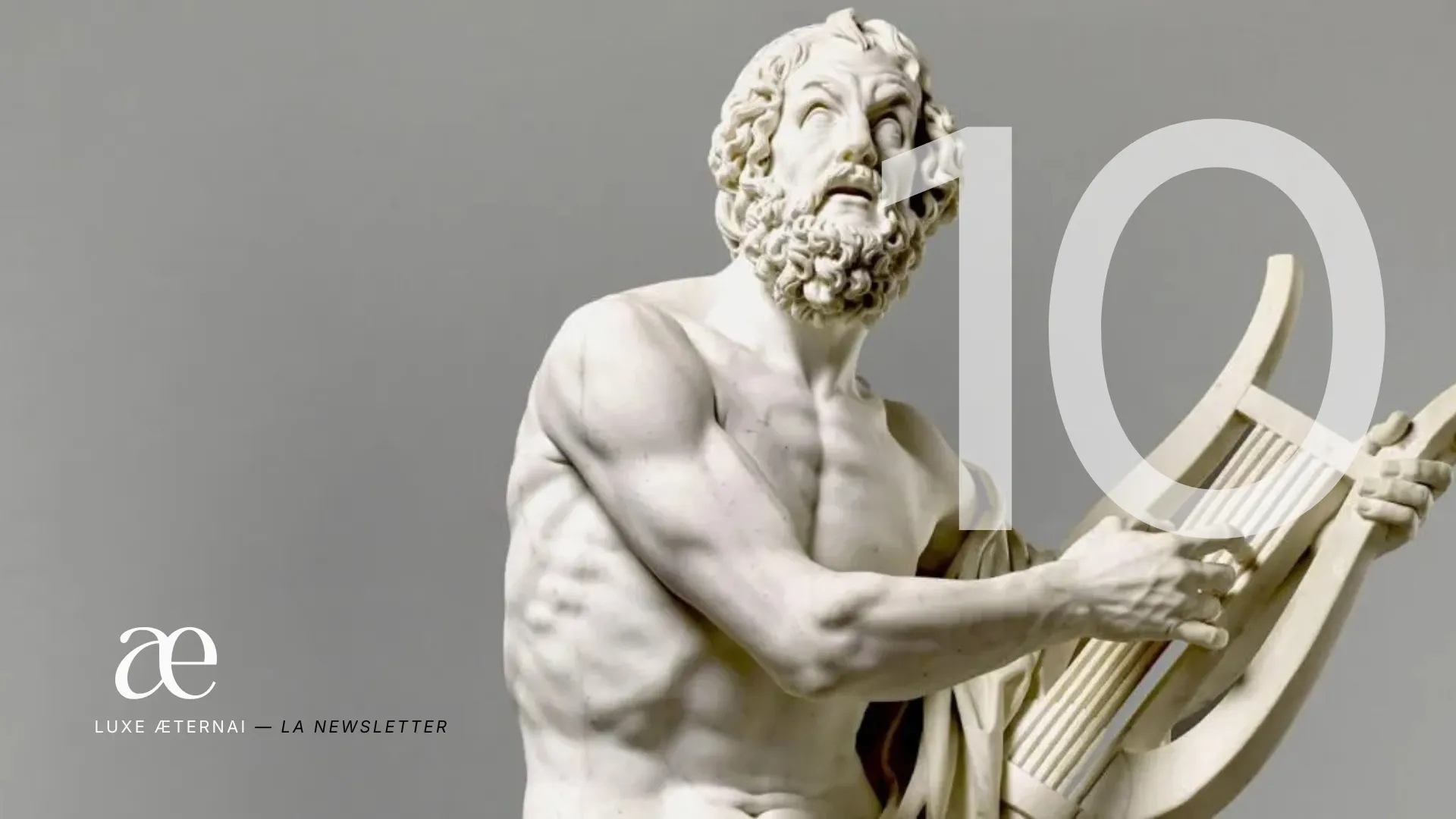
Homer's Lesson
Giorgio Colli, in The Greek Wisdom, recounts a story that goes back at least to the sixth century BC. The poet Homer is sitting on a rock, facing the sea of Ios. A boat of young fishermen passes by. He asks them whether they have caught anything. They answer with a very solemn formula:
"What we caught, we left behind. What we did not catch, we carry with us."Fishermen of Ios, reported by Giorgio Colli, The Greek Wisdom
The phrasing is noble. The referent is trivial: lice. The ones they caught have been crushed; the ones they did not catch they still carry in their clothes. Homer does not know how to interpret the riddle. He loses heart and dies "of despondency." Colli calls it "a sublime cognitive failure."
The illustrious author of The Iliad and The Odyssey ends up dying of despair because he was able to read every epic in the world, but not the sentence pointing to his immediate tacit. The fishermen's phrase is, twenty-six centuries before the Adobe Summit, a perfect formulation of the Pact of Legibility. What we caught, we left behind: the signal that has been encoded loses its rarity value. What we did not catch, we carry with us: the tacit preserved remains the raw material of what constitutes. Luxury has always carried what it had not said. What remains is to figure out which signs to use to encode silence so that it survives reading.
Additional sources: Giorgio Colli, After Nietzsche, on Homer's death ; WIRED, AMI Labs raise, March 10, 2026 ; David C. Edelman, Think with Google, April 2026.
THE STORY: Ascott × Cubby × Accenture × Amadeus
While Bernard Arnault was at the lectern of the Carrousel du Louvre, Kevin Goh, CEO of The Ascott Limited, was running an event of a different register in Singapore. Ascott is not a luxury house in the strict Comité Colbert sense. It is the hospitality arm of CapitaLand Investment (CLI), an Asian real-estate asset manager listed on the Singapore Exchange and one of the largest hotel operators in Asia. More than one thousand properties under fourteen brands, in two hundred and thirty cities: Ascott for high-end residences, Citadines for city centers, Somerset for expat families, lyf for digital nomads, Quest for Australia. Not ultra-luxe in the Aman or Cheval Blanc sense, but operational premium hospitality: robust, internationalized. And that is precisely why the signal counts.
The market: $1.6 trillion according to the Travel Forward 2026 report from Phocuswright. The projection: 61% of travel businesses are already experimenting with or scaling agentic AI, per the same source. IDC projects that 30% of travel bookings will be executed by AI agents by 2030. But, and this is where luxury must pay attention, Skift documents in its April 2026 survey a striking gap between executive enthusiasm and actual adoption: 80% of travel executives plan deployment at scale, but only 2% of U.S. consumers say they are ready, at this stage, to use fully autonomous booking agents. Agentic adoption rises from the top of management long before it reaches the bottom of the market. The house that goes agentic too quickly risks writing a pact its customers have not yet signed.
What was announced
On April 23, Ascott formalized a complete re-architecture of its distribution infrastructure around three simultaneous partnerships:
- Accenture for the AI-ready layer of the digital architecture
- Amadeus for the central reservation system, redesigned as API-first (built on ACRS, the Amadeus Central Reservations System)
- EHL Hospitality Business School for training human teams on a guest journey reshaped by AI
At the heart of the setup: Cubby, the digital concierge launched by Ascott in 2023. The public counter formalized in the release: "more than 900,000 guest enquiries" since deployment. And a strategic pivot: Cubby, until now positioned as a "travel companion," shifts to the role of "personal travel agent," "moving from conversation to orchestration by anticipating guest needs and acting on them before they have to ask." Concretely, Cubby is now authorized, in pilot, to compare options, plan itineraries, and complete bookings without human intervention.
The quote that says it all
"Agentic commerce represents the biggest shift in commerce in the last 20 years."Emily Weiss, Senior Managing Director & Global Travel Industry Lead, Accenture
Twenty years, meaning the previous benchmark was the rise of mobile e-commerce in the mid-2000s. The framing is deliberately maximalist. But coming from Accenture, the world's leading tech integrator for retail and hospitality groups, it tells you the level of investment that boards are now signing off on.
The stack and the frameworks
Cubby relies on LLMs, on Model Context Protocol frameworks (MCP, the protocol designed by Anthropic to let AI agents interact with third-party systems), and on the Amadeus platform in API-first mode. The term that recurs in the release and in the specialist analyses: "unified commerce," a logic in which content, inventory, prices, and customer profiles are structured to be read indistinctly by a human or by an agent.
The competitive map of agentic hospitality
On the giant side, Marriott International announced in February 2026 its agentic mesh architecture, a shared orchestration layer of reusable agents across the group's functions. Anthony Capuano, CEO of Marriott, has confirmed a $1.1 billion tech investment in 2026, with more than a third allocated to digital transformation, and a partnership with Google AI Mode to process bookings directly inside the AI Mode interface (not just to return a link). Marriott is also testing a partnership with OpenAI as part of the ChatGPT ad pilot program. Hyatt and IHG remain silent on their public roadmaps. On the true ultra-luxe side (Aman, Cheval Blanc — LVMH, Mandarin Oriental, Four Seasons), no agentic AI signal was emitted in the April 20–27 window.
Why this matters for luxury
Three readings.
First, agentic adoption rises from the bottom of the hospitality segment. Not from the top. It is the same mechanic we saw in fashion with Balenciaga × Intelo.ai (edition #9): the operational move precedes the communication of the largest houses. By the time ultra-luxe communicates, it will be at least eighteen months behind on the ground.
Second, the Accenture × Amadeus × EHL partnership is a triad signal. Technology alone is not enough. You need a software-infrastructure layer, an interoperable distribution layer, and an HR-reinvention layer. No luxury house can settle for buying an agent. The pact requires a simultaneous overhaul of all three floors.
Third, the Cubby leap (from "companion" to "agent") formalizes a threshold that other houses are crossing in silence. When an AI concierge moves from response to transaction, you shift from conversational to orchestration. From there, the customer no longer visits the house; the agent negotiates in their place. What was legible at the surface becomes actionable in depth. And there is no sense, for a house that has not written its Pact of Legibility, in letting the agent decide on its behalf what gets read.
Sources: The Ascott Limited, release April 23, 2026 ; TTG Asia, April 24, 2026 ; Phocuswright, 61% travel businesses agentic AI ; IDC, agentic AI hospitality 2030 ; Skift, agentic AI travel booking ; Hotel Technology News, Marriott agentic mesh ; Skift, Marriott × Google AI Mode ; Anthropic, Model Context Protocol.
MY INDISCREET QUESTION
What share of your brand have you explicitly encoded for AI agents, and what share have you decided, deliberately, to keep in silence?
If no one in your house can answer, then no one is holding the Pact of Legibility. And a pact no one holds yields to reading by default. The agent's. Or your competitors', the ones who wrote theirs.
Luxury has always known what it did not say. What remains is knowing what it agrees to write.
ON MY READING LIST
- David C. Edelman, "With AI, the Customer Journey Contracts," Think with Google FR, April 2026. The best French-language synthesis of the BCG × Google 4S framework (Streaming, Scrolling, Searching, Shopping) applied to the post-LLM purchase journey. The line to remember: "the brand must be conceived as the sum of the signals that make it identifiable as a solution." That is the marketing formulation of the Pact of Legibility.
- Steven Levy, "Yann LeCun Raises $1 Billion to Build AI That Understands the Physical World," WIRED, March 10, 2026. The portrait of the AMI Labs raise, with long LeCun quotes on the strategic dead end of LLMs. Read it to understand why every executive investing in agentic must keep the architectural-shift calendar on their desk.
- CNIL LINC, "Are There Humans in the World Models?" April 8, 2026. The French-language référence on the LLM → world models transition, with the questions of rights and data provenance. Read it alongside LeCun.
- Reynald Fléchaux, "After 5 Years of Data and AI, LVMH Explores Agentic," CIO Online, December 4, 2025. For historical context: Franck Le Moal's statement on the industrialization phase, the Maia agent open to 200,000 employees, the Voices agent deployed at Bulgari, the Tiffany and Céline clienteling pilots. What the April 23 AGM confirmed in fast-forward.
COMING NEXT
VivaTech Paris, June 11–14, 2026. Europe's largest tech gathering. The LVMH × tech-partner pavilion is expected (Dior, Bulgari, Louis Vuitton, on the model of the VivaTech 2025 partnerships). It will be the first major luxury showcase post-EU AI Act Article 50, which becomes enforceable on August 2, 2026. The thread to follow: how will the houses publicly present their agentic strategy when disclosure becomes mandatory and silence is no longer a legally tenable option?
And in the meantime, two signals to watch: the publication of the Bernstein, Morgan Stanley, and HSBC analyst notes after the Kering Florence CMD (the analysis of the Pinault group's group-wide agentic AI platform, which will feed edition #11), and the major French houses' reaction to the DDG Avocats grid on Article 50.
And to write this pact before others write it in our place. Luxe oblige !