
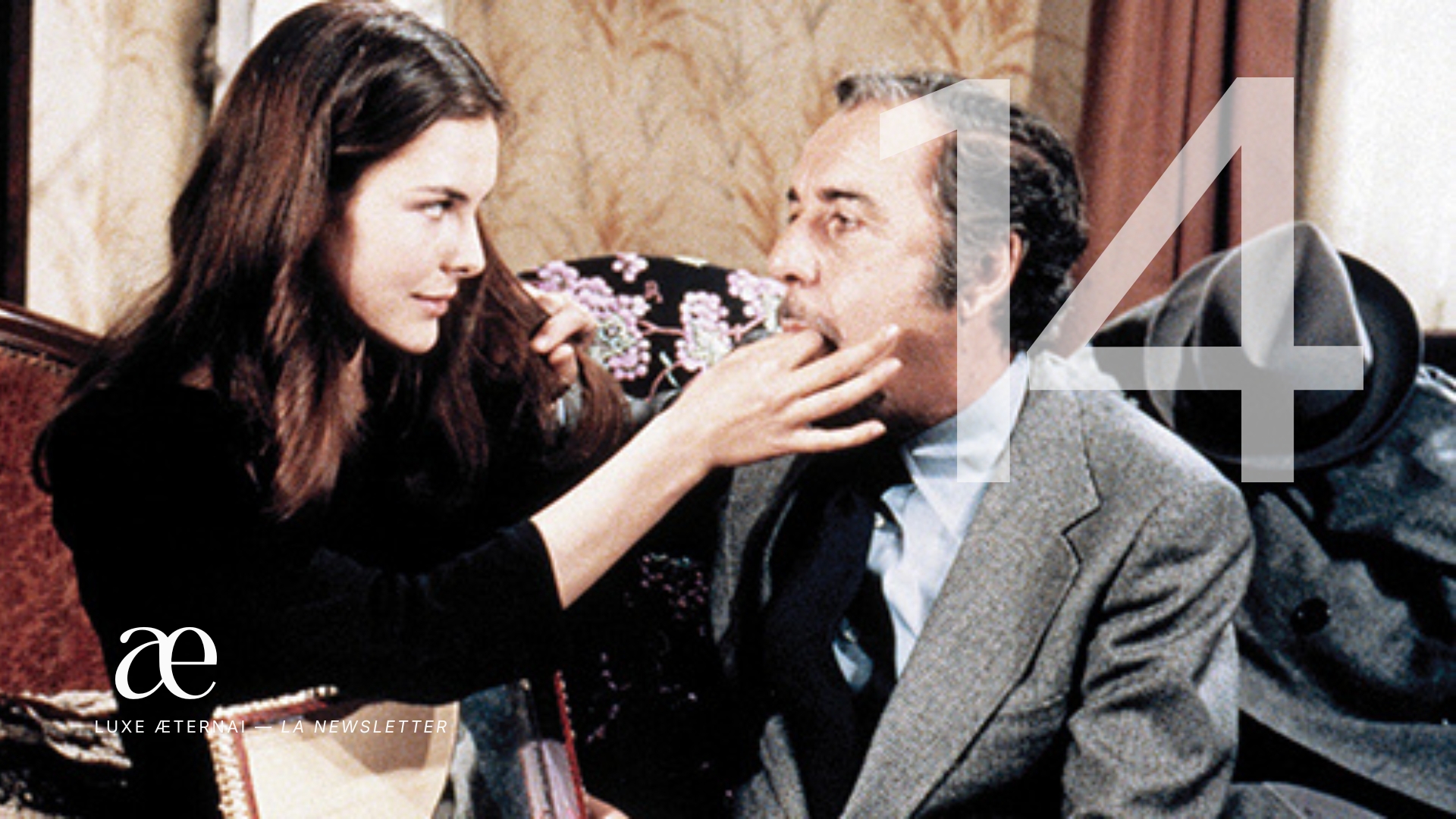
In 1977, Luis Buñuel shoots his final film. To play Conchita, the object of desire of an aging bourgeois, the director makes an unprecedented decision: he casts the same character with two different actresses, who alternate from scene to scene without the slightest narrative justification. The object of desire remains obscure, double, ungraspable.
This is exactly what AI agents are trying to erase today. They seek to pin down the client's desire into a behavioral cluster, a propensity score. And the Luxury client refuses to be pinned down.
Refusing to be pinned down does not mean refusing AI. It means knowing where to place it. The houses that will win in 2026 industrialize agentic artificial intelligence behind the scenes (product allocation, internal clienteling) and preserve intact the human encounter on stage.
Edition #12 defended a thesis: privacy was not the marker of the new Luxury — signature was. That remains true downstream, against the falsification of brand content. But upstream matters just as much. Privacy and signature protect the same rent: what cannot be extracted upstream, what cannot be falsified downstream. One single thing, with two faces. One name: the inextractable.
The inextractable refers to everything Luxury produces that cannot be reduced to data, and which becomes, in 2026, monetizable as such. The encounter with the concierge who remembers you without a CRM (Customer Relationship Management). The gesture of the sales advisor who slows down because she has noticed a detail. The silence of the salon. Everything that happens between the data. The market has just put a price on it. The question is no longer for or against agentic AI in Luxury. It is: where to place it so that it serves, and where to keep it at a distance so the object of desire remains, as in Buñuel, obscure.
Welcome to LUXE ÆTERNAI: my weekly decoding of what AI agents change, or do not change, for Luxury houses. I am Mickaël Tsakiris. Twenty years in Luxury, on the brand and digital agency side, from Saint Laurent to LVMH via Dior, Chanel and Hennessy. I help houses and executives turn agentic AI into a competitive edge, while preserving their DNA. Enjoy!
The essentials of the week.
Vogue Business, May 5. 1% of Luxury clients find AI recommendations "fully useful," 24% trust the agent, 3% consult chatbots for inspiration. The agentic promise falls flat on the high-end segment.
Tapestry × Coach. The patented Global Data Fabric and the AI platform Mira (announced May 11, 2026 on Amazon Bedrock) replace weekly allocation reports. Q3 FY26: +21% group revenue growth. Proof, in the numbers, that backstage agentic AI creates margin.
Google I/O, May 19. Universal Cart industrializes agentic commerce across Search, Gemini, YouTube and Gmail. Two LVMH entities in the partner list — Sephora and Fenty Beauty. But no Luxury Maison in the strict sense: not Louis Vuitton, not Dior, not Givenchy. LVMH itself draws the line.
ASOS Stylist × ChatGPT, May 20. Three minutes for the agent to recommend Tom Ford to a smart casual client. The agent found. It did not sell for ASOS — it sent the client to Tom Ford. The client trusts the agent to find. They trust the human to choose.
Encyclical Magnifica Humanitas by Pope Leo XIV, May 15. "The uniformity that erases differences, the pretension of a single language — including a digital one — capable of translating everything, even the mystery of the person, into data and performance." The Vatican names the extraction.
Distrust that becomes signature.
The more the machine learns to recommend, the less Luxury clients trust it. The more platforms extract, the more non-extraction becomes a selling proposition. The paradox of agentic AI in Luxury does not pit humans against algorithms. It overturns a fifty-year-old model, in which giving up one's data was the price of personalized service.
As that personalization becomes commonplace, value shifts elsewhere. To what is not asked, not stored. The real houses have always known their clients without extractive databases. They knew them by the memory of an advisor, by the asymmetry of a salon. And behind that discretion, they have also, in recent years, deployed a massive agentic infrastructure the client never sees. Both work together.
Three signals this week.
Google Universal Cart: LVMH plugs in its retail, protects its Maisons
On May 19, 2026, at the Google I/O conference, Sundar Pichai (Google CEO) announces Universal Cart, an agentic shopping cart integrated transversally into Search, Gemini, YouTube and Gmail. The infrastructure relies on the UCP (Universal Commerce Protocol, already covered in our editions #1 and #2) and on AP2 (Agent Payments Protocol) for the payment layer. Launch partners: Nike, Sephora, Target, Ulta Beauty, Walmart, Wayfair, plus Fenty Beauty and Steve Madden via Shopify. Two LVMH entities on this list — Sephora (selective beauty retail, owned by LVMH since 1997) and Fenty Beauty (Kendo, an LVMH division). But no Luxury Maison in the strict sense: not Louis Vuitton, not Dior, not Givenchy. The largest Luxury group in the world draws the line itself, between what can enter Google's agentic cart — its multi-brand retail and its inclusive beauty arm — and what must stay out: its Maisons. AI Overviews have caused a 58% drop in click-through rates on the first organic result across 300,000 keywords analyzed in December 2025 (Ahrefs study by Ryan Law and Xibeijia Guan).
Sources:
- Official Google blog, 05/19/2026
- Vogue Business, Savannah Fortis, 05/20/2026
- Stratechery, Ben Thompson, 05/20/2026 (paywall)
- TechCrunch, 05/19/2026
- Ahrefs study (Ryan Law, Xibeijia Guan), December 2025
ASOS Stylist × ChatGPT: the agent sends the client to the brand, not the reseller
On May 20, 2026, ASOS launches Stylist, its AI agent integrated into ChatGPT, powered by Bambuser (Swedish video commerce platform). The agent turns ASOS's catalog and video library into structured data for LLMs (Large Language Models). Available from day one in the UK and the US. Steve Webster, Digital Director at Barbour (British outdoor apparel house), tests the agent during the week and publishes the results on LinkedIn on May 26. He asks for a smart casual men's wardrobe. The agent recommends Mango, Jack & Jones, Thomas Crick. Then he moves to fragrance. The agent proposes Tom Ford Oud Wood and links directly to tomfordbeauty.co.uk. Not to ASOS. ASOS does not carry Tom Ford. In three minutes, the agent ASOS is funding to reach ChatGPT's 17 million users sent the client straight to Tom Ford's website. The reseller has been bypassed by its own channel. Webster's verdict: "The generalist agent optimizes for the expression of the need, not for the conversion rate."
Sources:
- Official ASOS plc press release, 05/20/2026
- Bambuser, 05/20/2026
- Retail Gazette, 05/20/2026
- Retail Tech Innovation Hub, 05/20/2026
- Steve Webster LinkedIn post, 05/26/2026
Pinterest, Equinox, Aerie, Even Realities: the grammar of refusal
Four signals converging in six months, across four distinct sectors. Pinterest rolls out, on October 16, 2025, an opt-out option for AI-generated content in fashion, beauty, art and home decor. Equinox (American premium fitness group) launches, on January 1, 2026, Question Everything But Yourself, a campaign signed by California agency Angry Gods, juxtaposing deliberately failed AI images with portraits of real bodies. Aerie (lingerie line by American Eagle Outfitters) formalizes its commitment No retouching. No AI. 100% Aerie Real from October 2025, amplified in April 2026 by a campaign with Pamela Anderson — Q4 2025 sales up 23%. Even Realities, a young Shenzhen brand founded in September 2023 by Will Wang (former Apple and JMGO engineer), prices its camera-less connected glasses at 599 dollars, against 379 dollars for the equivalent Meta Ray-Ban model with camera. Active refusal of AI is becoming a brand signature. Privacy is leaving the legal territory and entering the commercial one.
Sources:
- Vogue Business AI Tracker (weekly updates)
- Pinterest newsroom, 10/16/2025
- Ad Age — Equinox campaign
- Fortune — Aerie × Pamela Anderson, 04/30/2026
- Gizmodo — Even G2 review
The inextractable: what Luxury has sold for two centuries, and the architecture that makes it monetizable.
One word, which will return in every edition where client data enters into tension with client experience. Not a refusal of agentic AI. What it leaves intact when properly placed.
1%, 24%, 3%: defiance has a number
Vogue Business surveyed, in May, a sample of Vogue and GQ readers on their use of AI to shop. For a fashion magazine that depends on brands to live, the results are exceptionally harsh. 1% of clients find AI recommendations "fully useful." 24% trust the agent's suggestions. 3% consult chatbots for styling inspiration. Carol Aquino, Head of Consumer Tech at WGSN (Worth Global Style Network, the London-based fashion forecasting agency), reads privacy as a proxy for seriousness for Luxury brands — a sign that the house takes the client seriously. Patricia Egger, Head of Security at Proton (the Swiss encrypted email provider, co-founder of Women in Cyber Switzerland), states the bare rule: "If you're not paying with your money, you're paying with your data."
The Luxury client, however, pays with their money. And they are beginning to demand that the other currency no longer be asked of them.
The number that opposes this refusal, at the macro level, is staggering: Meta, Google, Microsoft and Amazon are investing 725 billion dollars in AI capex for 2026, against 410 billion in 2025 — a 77% year-on-year increase (compilation by the Financial Times from Q1 2026 earnings, commented by Brent Thill, Jefferies). The historical budgets of several states, spent to recover what the Luxury client now refuses to surrender.
Sources:
- Is Privacy the New Luxury? — Vogue Business, Amy O'Brien, 05/05/2026
- Big Tech AI spending $725 billion in 2026 — Tom's Hardware, 04/30/2026
- Statista — Big Tech AI Capex 2026
What Luxury already practices, without naming it
A palace concierge does not store your breakfast order in a shared CRM. He remembers it. That is different. The Hermès salon vendor does not trigger a personalization journey when you walk in. She slows down. She observes the wrist, the shoe, the breathing pattern. She decides, within the second, which of the four available Birkins will not come out of the back-shop today. That is her skill. No one trained her by human reinforcement. And no model will replicate her across five thousand stores.
This competence belongs to what the philosopher Michael Polanyi called, in 1958, tacit knowledge (Personal Knowledge, University of Chicago Press) — knowledge that takes shape in the gesture and resists any formalization. In The Tacit Dimension (1966), Polanyi distilled it into the famous formula: "we can know more than we can tell." The sociologist Richard Sennett brought this concept back to the heart of the analysis of craftsmanship in The Craftsman (Yale University Press, 2008). Luxury has lived off it for two centuries. It has called it discretion, savoir-faire, the art of restraint. It has never called it a "data strategy." That is precisely what now needs to begin.
Best-in-class: the agentic AI that creates value backstage
The blind spot in the public conversation on AI in Luxury is that the houses that are winning use agentic artificial intelligence massively — but have placed it where the client never sees it. Two cases published this spring, and a third I detail in THE STORY below.
Lyst and the agentic translation of taste. On the fashion marketplace Lyst (UK-based aggregator founded in London in 2010, 17,000 brands listed, acquired by Zozo in April 2025 for 154 million dollars), Rich Shepherd, VP Product, sums up the doctrine (quoted by Vogue Business, translated from English): "The best buyers always cut by instinct. AI just tells them where that instinct will carry the most weight." The recommendation engine has moved from catalog ranking to suggestion by style, based on taste signals rather than raw popularity. Miyon Im, VP of Product Design, points to the emerging role on the teams (translated from English): "Merchandising used to mean the first six products you saw in a feed. With AI, you become more sophisticated: around styling, around the outfit, around the event-based suggestion." The merchandiser becomes a translator between analytical signal and creative strategy.
The agent does not decide. It prefigures. The human cuts.
Ralph Lauren, eight months after Ask Ralph. Edition #1 had analyzed, in September 2025, the launch of Ask Ralph, the house's conversational agent built into its application — closed perimeter, proprietary environment. On May 22, 2026, at the FY2026 annual results presentation, Patrice Louvet, Ralph Lauren President & CEO, extends the doctrine: "We accelerated the iteration of core icons in the design process, successfully integrated automation to support teams in our global distribution centers and enabled brand discovery across agentic search and commerce." The sentence is dense. It says AI now operates in creation (the core icons of the catalog: sweaters, rugby shirts, outerwear, handbags), in logistics (distribution centers), and in external visibility (agentic search). But not in the human in-store client relationship, which remains carried by the trained sales advisors in the network. Results: annual revenue at 8.11 billion dollars for the first time, Q4 growth of 12% at constant currency, Average Unit Retail (AUR) up 16%. The house that masters the architecture masters the numbers.
Sources:
- Vogue Business, Morgan Harris, 04/23/2026
- Ralph Lauren Q4 2026 Earnings Transcript — Motley Fool
- Glossy — Luxury Briefing, 05/22/2026
My study The client, the brand, and the agent: Luxury's new ménage à trois? (April 2026) summarized Luxury's new love triangle in two sentences.
The client trusts the agent to find. They trust the human to choose.
The inextractable starts there. Not in the refusal of the agent. In the human channel no agent can replace.
What needs to happen now
Four concrete moves, for CEOs and digital directors.
- Map your current agentic architecture, separately by zone: operations, design, supply chain, marketing, client relationship. Most houses mix the zones in a single dashboard and lose the reading. Tapestry separates. Ralph Lauren separates. That is the first condition to be able to arbitrate.
- Write the client charter. Not a legal document: a brand document, readable by a client, signed by the CEO, that says what you will never do with their data, even when the technology will allow it. Most current Terms of Service say the opposite: they expand possible uses. Taking the counter-position becomes distinctive.
- Open at least one explicitly non-extractive channel — store or personal advisor — backed by a contractual no-storage promise. The client will pay the delta. They already pay 599 dollars for camera-less connected glasses. They have paid for thirty years for first-class airline tickets to avoid being seen in security lines. Non-extraction belongs, economically, to the same register: a contractual rarity that Luxury knows how to price better than anyone.
- Appoint someone in charge. Not a legal Chief Privacy Officer tucked away in the third basement. A member of the executive committee who answers, to the CEO, for the arbitrations between operational agentic AI and the client's inextractable. Today, these two responsibilities are scattered across three directions (technical, legal, marketing) that do not speak to each other. That is why the architectures get blended.
The serious objection remains. Scale. How do you sell to ten million clients what the historical house sold to ten thousand? The answer is not symmetrical. The inextractable does not replicate as a standardized product; it segments. The client who wants a fully agentic experience must be able to have it. The client who wants not to be tracked must be able to have it too — and it is this second option that has now become distinctive.
"However data-driven technology is, fashion still involves instinct. When you merge the two in a simpatico way, that's when magic happens."
— Julie Gilhart, Senior Vice President and Fashion Director at Barneys New York for eighteen years, quoted by WWD.
Well-placed AI augments. Misplaced, it dilutes. One still has to know the boundary.
Tapestry × Coach: the fabric of data that reallocates before the stock is committed.
On April 23, 2026, in Vogue Business, Fabio Luzzi, Chief Data & Analytics Officer of the Tapestry group (parent of Coach and Kate Spade since the Stuart Weitzman divestiture in August 2025; 7.0 billion dollars in revenue for the fiscal year ended June 28, 2025, of which 5.6 billion for Coach alone), publicly describes the data layer that now underpins the group's allocation and merchandising. The house calls it Global Data Fabric, its patented data tissue (the group's first AI patent, filed in the United States, announced May 11, 2026). Tapestry means tapestry. Data fabric means tissue. The vocabulary says, word for word, what edition #12 called L'ENTOILAGE AGENTIQUE — the agentic interlining: the AI layer that holds the garment from the inside, never visible on the right side. The concept was French and theoretical. Tapestry has just industrialized and patented it. The layer is built on AWS (Amazon S3, AWS Glue, Redshift, EMR, SageMaker) and Snowflake, and since May 2026 hosts the proprietary AI platform Mira, deployed on Amazon Bedrock for cross-functional shared analysis.
The concrete example Luzzi gives fits in one paragraph. A member of the buying team opens a dashboard. He sees that a silhouette is over-performing in the American Southwest and under-performing in the Northeast. The information used to reach him in sales reports published several weeks later, sometimes after the stockout had already happened in the wrong region. Today, the signal arrives before the allocation decision is taken. The merchandiser can redistribute immediately, without committing inventory in the wrong direction. Luzzi (translated from English): "We always knew that, to digitize this process and scale fast, we needed an ability to host and share the data easily across the business." Joanne Crevoiserat, Tapestry's CEO, confirmed it when announcing Mira: "Mira is a powerful tool that puts business insights into the hands of decision makers across the company."
On Coach's core leather goods — emblematic models that have been on the catalog for twenty years, 931 stores worldwide as of June 28, 2025 — the agentic layer prefigures replenishment decisions and alerts the merchandiser in real time; final validation remains human on the strategic perimeter, automatable on the high-rotation basics. Q3 FY26 (published on May 7, 2026) shows 1.92 billion dollars in group revenue, up 21%, DTC at +23%, digital at +25% — figures Tapestry explicitly attributes, in its press release, to "years of deliberate investment in our data infrastructure." The merchandiser keeps his time for the categories where data leaves less certainty, and where human judgment weighs more. Three decisions structure the architecture.
- Client data centralized, never published. It is exploited internally, never resold, never exposed to a third-party agent. The client's inextractable is preserved.
- Agentic decision support on stable items (core, basics) and human arbitration on culturally sensitive items (trends, runway, capsules). It is the exact architecture: AI full backstage, creative decision on stage.
- Infrastructure replicable across business units. Kate Spade inherits the same base (without having to rebuild it), and the Global Data Fabric patent locks in the competitive edge.
What this architecture changes, on the ground, is very concrete. The Coach store director in Houston no longer receives the weekly report that told him, on Tuesday, that the stock missed the previous weekend was available in Phoenix. He now sees the signal in real time, and the central merchandiser has already rebalanced. The conversation between the field and headquarters changes nature. They no longer discuss what happened. They discuss what is going to happen. For a listed group that has to defend its margins to analysts quarter after quarter, this cycle gain is the most underestimated margin pool in the sector. It does not show up in press releases, because it remains invisible on the client side. It shows up in the numbers, because gross margin never lies.
Sources:
- Vogue Business, Morgan Harris, 04/23/2026
- Official Tapestry IR press release, 05/11/2026
- Digital Commerce 360, 05/13/2026
- Retail Tech Innovation Hub, 11/12/2025
- Tapestry 10-K FY2025 (SEC filing)
- AWS Industries Blog
Three questions for your executive committee.
Any one of them is enough to reveal the real state of your relationship with the client. All three together draw your true inextractable score.
- Of your 100 best clients, how many have a dedicated advisor within the house? And among those advisors, how many have been in place for more than five years? If either ratio is below 60%, you are extracting what you should be preserving. The memory of a senior advisor is worth more than your entire CRM combined. And you lose it at every reorganization.
- How many of your 50 best clients have received, signed by your CEO, the explicit list of what the house will never do with their data? Zero? Welcome to the majority. It is also your attack point for 2026 — the first house that signs that document will take a lead the others will need three years to close.
- How many times do your 50 best clients have to repeat, in a single interaction with your house, their size, their allergy, their preference, their partner's first name or the vintage they ordered last year? If the answer is more than once, you are asking your best clients to compensate, with their cognitive effort, for the failures of your relational infrastructure. You are extracting what you should have memorized. And every repetition is a small blow to the rent — the rent of embodied memory, the very thing that distinguished your house from the platforms.
The fact of not asking these three questions does not erase their answers. They are being written, right now, in the turnover of your advisors, in the thickness of your terms of use, in the number of times your best client had to say their first name again on the phone. None of those indicators sits on a Luxury executive committee dashboard in 2026. That is precisely why the rent is still there — and why it is up for grabs.
The agent that never leaves the phone: the next frontier.
Tapestry, Ralph Lauren, Lyst have proven that a well-placed agentic AI creates measurable value. The question, for the next twelve months, is no longer "does AI work?" It has become: "how far can we push it without touching what constitutes the heart of the human client relationship?" The agentic technology that runs on the client's own device is the next frontier. No Luxury house has yet answered it publicly.
The technology already exists. Apple delivered its Foundation Model (3 billion parameters, fully local execution on the Neural Engine from the A17 Pro chip onwards) with iOS 26 on September 15, 2025, and opened it to third-party applications in that same version via the Foundation Models framework. Microsoft has deployed Phi Silica (3.3 billion parameters) on Copilot+ PCs from late 2024. Google has rolled out Gemini Nano on Pixel devices since December 2023. Meta released Llama 3.2 1B and 3B in mobile versions in September 2024. No token leaves the device. No request is logged. No history trains anything on the platform side.
The potential audience is massive: 2.35 billion active Apple devices worldwide, of which 1.4 billion iPhones, and a growing fleet of Pixel and Copilot+ PCs. On-device natural-language analysis today exceeds what GPT-3.5 did in the cloud in 2023. And yet, to date, no first-rank Luxury house has publicly announced an on-device deployment of its client relationship agent. The gap is exactly the one identified for the C2PA signature in edition #12: the technology exists, the standard is open, the enterprise layer is in production. Luxury watches.
Three prospective use cases over eighteen months.
- The non-extractive concierge application. A Luxury hospitality house (Aman, Cheval Blanc, Mandarin Oriental) releases an application whose concierge agent runs entirely on the client's iPhone. Profile, food preferences, allergies, stay habits, upcoming agenda: everything stays local, encrypted on the phone's secure enclave. The house keeps only an anonymous identifier and the reservation confirmation. The client then boasts of non-extraction the way one boasts of an exclusive service. The house communicates on the chain: "Our app knows nothing about you. You know everything about it." It is a differentiating communication act, technically executable today.
- On-device styling, with local photo library. Imagine the exact opposite of the Stitch Fix model. A wealthy client grants, once and for all, read-only access to her local iPhone photo library. The Apple Intelligence agent goes through the images, identifies pieces she already owns, picks up the cuts and the contexts (interior, travel, event). Burberry, Loewe or Bottega Veneta generates its recommendations from a locally downloaded catalog. Only the final order goes back to the house's server. The brand knows the transaction. Not the wardrobe. No return loop, no cross-brand profiling, no audience resale. For the client, an audible promise. For the house, an asset Google and Amazon cannot replicate, because they live off the opposite model.
- The advisor's voice journal. Hermès, Brunello Cucinelli, Chanel, Dior: these houses cultivate advisor-client relationships that span fifteen or twenty years. The advisor knows the family, the birthdays, the sizes, the tastes. All of this currently lives in a mixture of paper notebooks, human memory, and fragments of a CRM that is rarely up to date. An on-device agent records the advisor-client conversation with explicit consent, transcribes locally via Apple Intelligence, generates structured notes and suggestions for the next contact, without the raw audio ever leaving the advisor's phone. The house captures the tacit knowledge theorized by Polanyi and re-mobilized by Sennett (see DECODING), without letting it leak to a cloud provider. For HR, it is the formalization of the human asset. For the brand, it is the opposite of the extractable database.
The economic case fits in three lines. A senior advisor in a jewelry house costs between 800 and 1,200 euros of loaded cost per day. An average sale assisted by him yields between 25,000 and 80,000 euros of gross margin. Relationship continuity, captured locally rather than lost at every departure or reorganization, far outweighs the cost of industrializing an on-device agent, which amortizes in less than a year. It is not a digital transformation expense. It is an insurance policy on the house's human capital.
Testable demo this week, if you want to see what exists. On a recent iPhone running iOS 26, open Apple Notes or Apple Mail and ask for a summary of a long thread: the processing happens with no network connection, verifiable in airplane mode. On a Copilot+ PC, Microsoft Recall — deployed in general availability in April 2025 — records user activity only after opt-in, encrypted, in the Windows VBS enclave, never in the cloud. On a Pixel 8 Pro, 9 or 10, the Pixel Recorder app, powered by Gemini Nano, summarizes up to 41 minutes of audio without the raw file ever leaving the device.
Technical sources:
- Apple Newsroom, 09/29/2025
- Apple Machine Learning Research, 06/09/2025
- Microsoft Windows Experience Blog — Phi Silica, 12/06/2024
- blog.google — Pixel feature drop, 12/06/2023
- Meta — Llama 3.2 launch, 09/25/2024
- Windows Central — Recall GA, April 2025
The full technical chain exists. The components are mature. The enterprise layer is in production at Apple via the Foundation Models framework, at Microsoft via Phi Silica, at Google via the Gemini Nano API. And no first-rank house has published a doctrine or a deployment to date. Eighteen-month wager: by fall 2027, a first house will announce, in a posture of brand trust, that its agentic client relationship is entirely on-device. It will publish the technical documentation, integrate a verifiable badge, write non-extraction as article 1 of its charter. Agentic AI everywhere in the internal service chain. Client data, never in the cloud. All the other houses, within the next twelve months, will follow — or lose comparative credit.
The charter will be signed. The data, it will not be.
To dig deeper.
- Amy O'Brien, Is Privacy the New Luxury?, Vogue Business, May 5, 2026. The raw observation, the hard numbers on Luxury clients' distrust of AI recommendations. Primary source of this edition.
- Morgan Harris, How Fashion Buyers and Merchandisers Are Adapting to the Age of AI, Vogue Business, April 23, 2026. The map of backstage best-in-class AI: Tapestry, Lyst, Farfetch told by their operational leaders.
- Savannah Fortis, Google Just Changed How We're Going to Shop, Vogue Business, May 20, 2026. Industrialization on Google's side and the shift from incumbent merchant to third-party agent.
- Ben Thompson, Google I/O, World Models, I/O Spaghetti, Stratechery, May 20, 2026 (paywall). The strategic framing: Google equips the ecosystem, OpenAI wants to be the interface.
- Encyclical Magnifica Humanitas by Pope Leo XIV, May 15, 2026, paragraph §10. To grasp how an anthropological language about AI is being formed, beyond the technological register.
- Steve Webster, LinkedIn post of May 26, 2026 on ASOS Stylist. The three-minute demonstration that funding the agent for 17 million clients does not guarantee capturing the conversion. Public post.
- Vogue Business AI Tracker, Amy O'Brien, weekly updates. A systemic watch tool to bookmark.
A new Luxury vertical.
Xavier Niel, Alain Ducasse, Rodolphe Saadé, Jean Moueix. A TelCom mogul, a chef, a shipowner, a winemaker. Four men with no common denominator, sitting at the same table of a young French company that has raised twenty million euros in a single round. Look for what they have seen coming. It is not a runway, not a suite at Cap Ferrat, not a necklace. It is a new vertical of Luxury, and with it nothing will be the same again. Special edition next Thursday. In the meantime, think about what you need to sanctuarize within your Houses to keep on cultivating, while embracing technology, what makes the desire of your clients arise everywhere in the world.
Luxury obliges.
— Mickaël Tsakiris
Paris, Thursday, May 28, 2026