
Since June, this software has learned three things it did not know how to do, and the fourth piece of news is a price that has collapsed. The library where open models are downloaded has changed owner. The bill of the companies that use this software has gone up without a single contract having been reopened. And a cashmere Maison has put a philosopher on its engineering team.
Three of these ten pieces of news call for a decision from your executive committee before the end of the quarter: the fifth (European law in the contract), the seventh (the bill) and the eighth (the meter). The other seven are simply to be known.
This letter usually says what a Maison must hold to when facing agents: the rule, the control, the refusal. This week, it says what becomes possible. Luxury has spent three years asking itself whether the agentic was a threat; the software vendors have spent those same three years selling it as a promise. Between fear and advertising there is a third position, and it is ours: that of the practitioner who recognizes excellence of execution wherever it appears, because he has spent his life judging it, piece by piece.
That faculty has a name in our trades: the eye. I will call it here l'œil du Luxe (the Luxury eye), to say that it holds outside the atelier too, and I will tell you at the end of this letter where it stops.
"To infinity, and beyond," then! The title of this 22nd edition is Buzz Lightyear's cry in Toy Story: a toy convinced he is a space ranger, who throws himself into the void with absolute seriousness. Woody points out to him: "That's not flying, that's falling with style." The software of this new season does not quite know how to fly yet; it falls with a style no one knew it had in June, and it is that style this letter details.
A word on the term that runs all the way through. An agent is not an assistant that answers questions. It is software that acts: it chains steps together, opens other software, fills in fields, sees a task through without being prompted again. The difference with the AI we were talking about two years ago is the one that separates a catalogue from a salesperson.
Most of the time, it does not live in a separate application, or in a complex technical architecture reserved for experts. It grafts itself onto the tools your teams already open every morning, and most of them are at work there without your being aware of it.
If your teams talk on Slack, Salesforce announced on August 26 that Anthropic's model becomes the default one there. If your accounting runs on SAP, the vendor has been shipping since July agents that prepare invoice price discrepancies and expense reports, one of them still in beta, and lets the employee review before sending. If your projects live in Jira, an agent has been creating tickets there without asking for confirmation since August 5.
If your customer service is on HubSpot, every conversation resolved without a human is billed to you at $0.50. And if you are recruiting, I noted it in #20: 145 LVMH job listings in Canada warn the candidate that an artificial intelligence will read their application.
Welcome to LUXE ÆTERNAI, my weekly decoding of what AI agents change, or don't, for Luxury Maisons. I am Michaël Tsakiris. Seventeen years in and for Luxury, from Saint Laurent to Hennessy, on the Maison side and then in agencies. My trade today: writing the narrative that brings a Maison to embrace its agents, training its teams until the usage holds without me, identifying the tasks to entrust to agents, then designing, integrating and managing the chains of tasks they carry out (what the trade calls agentic workflows). This issue does not follow the usual sections. Enjoy!
1. Since July 6, OpenAI's voice assistant listens and speaks at the same time. 
Until June, talking to a voice assistant was talking into a walkie-talkie. You spoke, you fell silent, it answered. One direction at a time. Engineers call this half duplex, after the military radios where you say "over" to hand back the air.
On July 6, OpenAI put GPT-Realtime-2.1 into service. The specialist press speaks of full duplex: a model that listens and speaks at the same time. The vendor's documentation, more sober, names what has changed: "improved alphanumeric recognition, silence and noise handling, and interruption behavior." The software decides several times a second whether it takes the floor, whether it yields it, whether it waits, whether it cuts in.
What this opens up for a Maison. In high jewelry, silence is not a gap in the conversation: it is a gesture, as much as the way one sets a case down on the velvet. The great salespeople have always known it: in front of an €80,000 piece, one says nothing, and it is the hesitation that speaks. Beginners fill that silence; the best let it settle. For the first time, a piece of software possesses the mechanics of that silence.
It does not yet know at which moment to place it; but it knows how to hold it. The gesture itself remains the salesperson's: knowing when to stay silent in front of that particular client, on that particular day, is not learned from documentation. For a Maison that has a machine answer its clients on the phone, the criterion to put at the top of the specification is not the speed of the answer, it is the capacity to stay silent.
A note on sourcing: the name "GPT-Live," which the press gives to this system, appears on no public OpenAI page I was able to open. What the vendor dates and stands behind in its documentation is GPT-Realtime-2.1.
2. Since August 11, xAI's agents have a computer in the cloud and work through the night. 
The agents xAI put into beta on August 11, for three of its paid plans, no longer live in a conversation window. Each user has a machine in a data center, shared by their agents, with memory, files and a web browser. The agent connects to the company's software and carries on with its work when no one is in front of the screen any more. On September 3, the offering was opened to companies, with the access controls and the audit log that go with it.
Anthropic has arrived on the same ground. Its documentation soberly describes what its agent does: open websites, read pages, click, type, fill in forms.
What this opens up for a Maison. It is not selling. It is what I called in #19 l'envers de l'atelier (the back of the workshop). A night of keying in delivery notes. Three hundred lines of supplier invoicing reconciled one by one. The first sort of a forty-year photographic archive, before the curator attributes it piece by piece, which remains their trade and will remain so. Work no one sees, and that takes up the days of people whose trade lies elsewhere.
The objection is real, and the vendors do not agree on it. The agents of xAI and of Anthropic connect to software with the credentials of the person who launches them. Atlassian removed on August 5 the confirmation prompt its agent raised in the middle of a task, because it broke the automation; Notion, on August 28, went the other way and taught its own to propose before writing. Two opposite models of control, sold in the same month. What the machine gains in autonomy, someone loses in control: before launching one, a Maison decides which account it uses, what that account cannot open, and whether a human validates before the act.
3. Since August 26, a sentence spoken to Gemini launches work that carries on for days. 
Google presented on August 26 a feature I read twice. You dictate an instruction to your phone. The work starts, carries on across several documents and several tools, and continues for days or weeks, even when you are not using the application, phone in your pocket.
What this makes possible inside a Maison. A store director crossing Paris between two appointments launches, by voice, the preparation of a recruitment interview for their store, the synthesis of their clients' feedback on the latest capsule, the analysis of their sales for the week. They reopen nothing. The work gets done.
Google publishes a figure: 63% of its assistant's users go through voice. No period, no calculation base, no definition of what an interaction is. It is a claim by the vendor, and I give it as such.
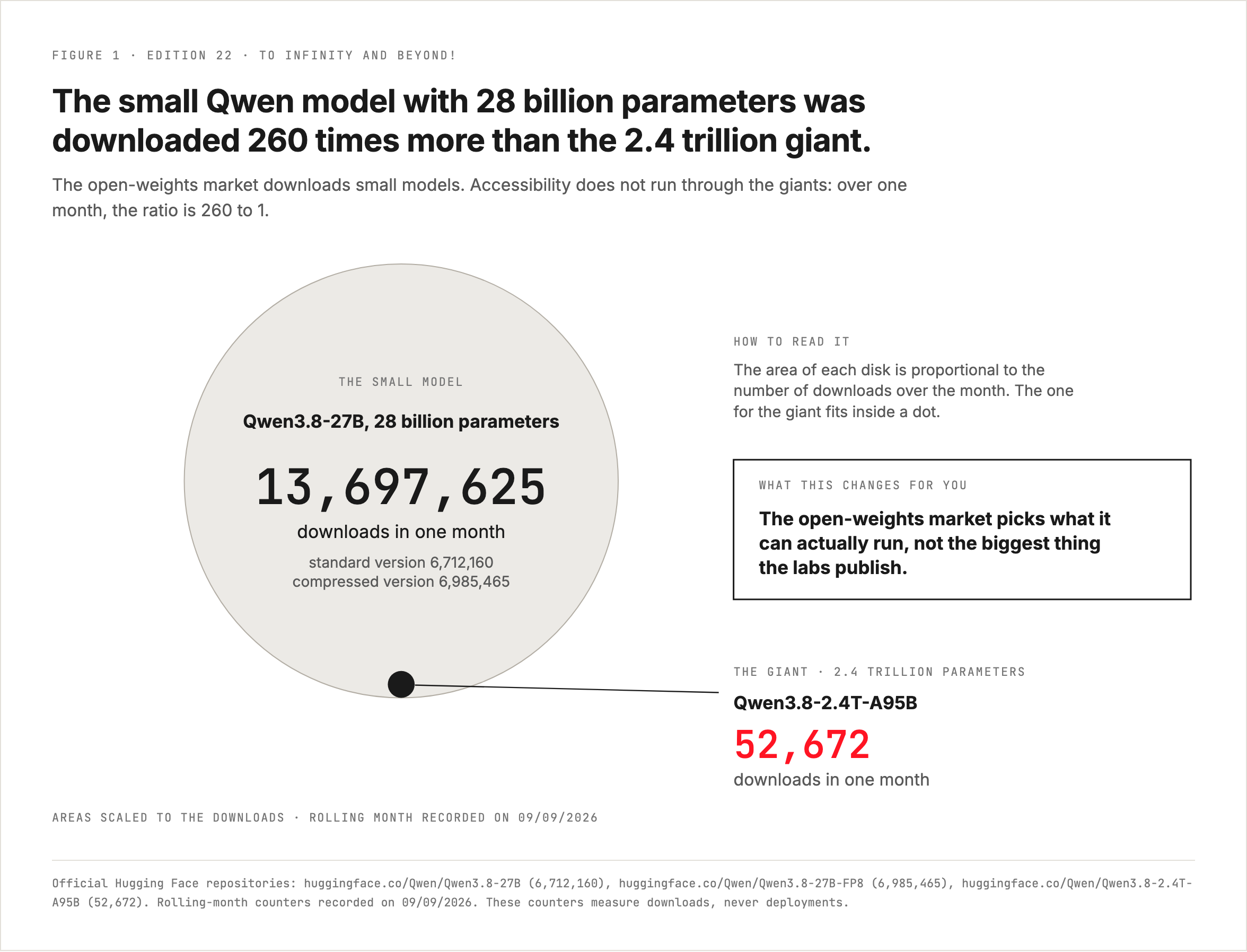
4. Kimi K3, a leading Chinese AI model, has been free to download since July 27. 
Three definitions first, because this section rests on them.
A token is the billing unit of these systems: roughly three quarters of a word. Everything they are given to read and everything they write is counted in tokens, and billed per million.
A model's parameters are its internal settings, the ones it learned during its training. Their number gives an idea of its size, not of its quality.
An open-weights model is one whose maker publishes the complete file free of charge: anyone can download it and install it on their own servers, provided they have the machines, which, for the largest ones, means a data center and not a server cabinet. Free does not mean unrestricted: every file comes with a license that frames commercial use, and no vendor on this list publishes the origin of the data its model was trained on. A closed model, by contrast, such as those of OpenAI or Anthropic, can only be queried remotely, paying at each use.

On July 16, the Chinese company Moonshot AI presented Kimi K3, 2.8 trillion parameters according to its spec sheet, which it presents as the largest open-weights model ever published. It put the file online on July 27, under an in-house license that frames commercial use.
Its chairman, Yutong Zhang, explains what they did this way: "We knew we didn't have the luxury to simply scale up compute. That forced us to focus on fundamental research and efficiency." Deprived of American chips by the embargo, the Chinese had to do better with less. Any head of an atelier understands that sentence.
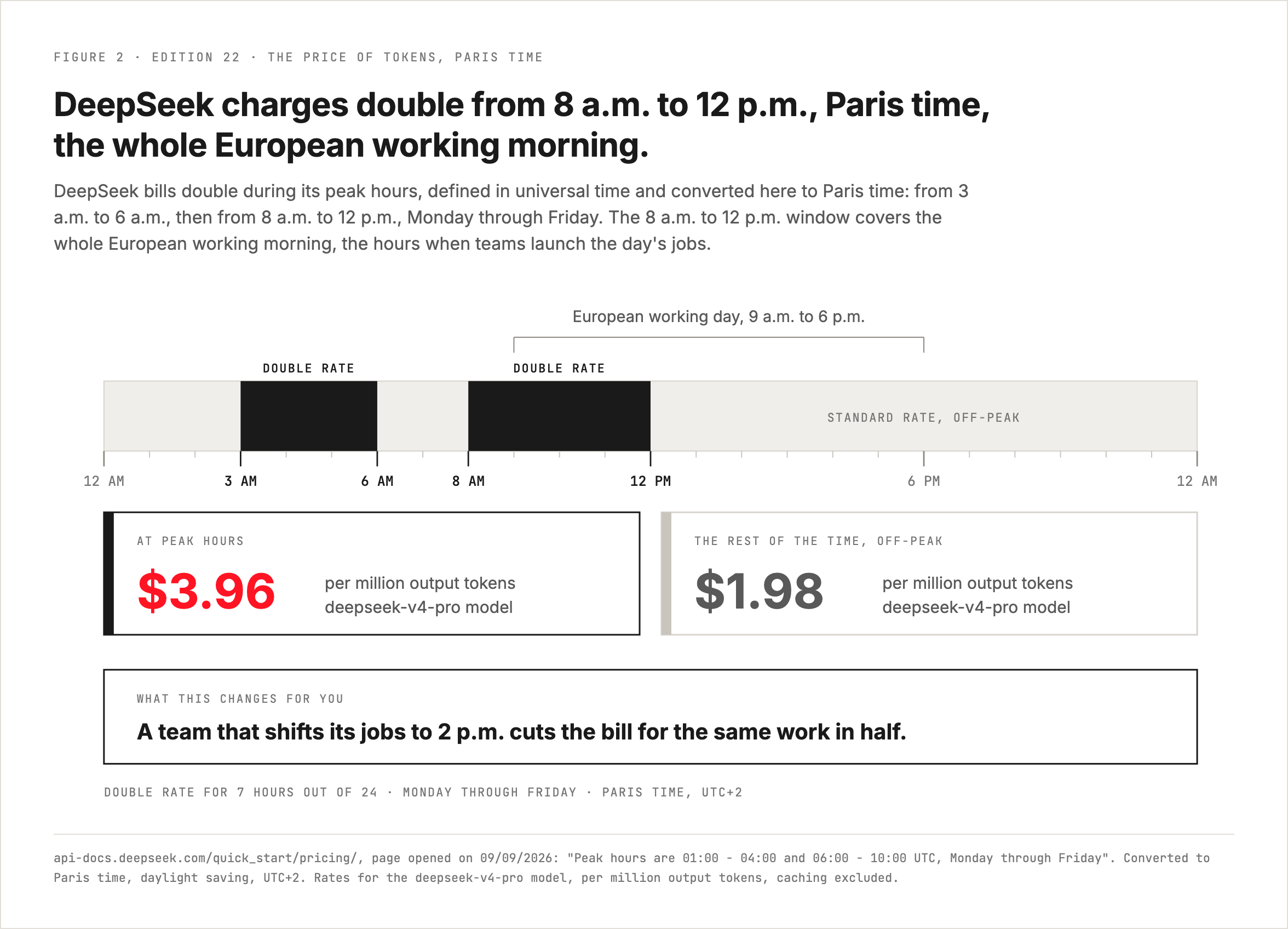
The price, for its part, has collapsed. At DeepSeek, another Chinese vendor, producing one million tokens costs $1.98 with its top-end model and $0.66 with its fast model, off-peak. Against that, Claude Fable 5.1, Anthropic's flagship model, charges $50 per million tokens produced. A gap of 1 to 25 on comparable models, and up to 1 to 75 on simple work.
Two clarifications, because they decide the budget. These rates double at peak hours, which DeepSeek sets, on working days, from 8 a.m. to noon Paris time, with a second window from 3 a.m. to 6 a.m.: the first covers the European working morning exactly. And they rose by 50% to 1,100% on August 17, depending on the model and the type of token. The conquest price has an end, and that end has a date.

What this opens up for a Maison. Translating twenty years of product sheets into six languages, describing an archive holding piece by piece, standardizing a catalogue of thirty thousand references: these projects ran into a quote. The quote has just been divided by twenty-five, and by more still if the work is launched in the afternoon. What was a project becomes a task.
The limit is clear. None of this holds for client data. A client file does not go into a service operated from China, and installing a model in-house calls for skills few Maisons have internally. These price gaps hold for what is not personally identifying; for what is, the next section brings an answer, with its own reservations.
5. On September 8, Mistral raised €3 billion, the largest technology raise ever carried out in Europe. 
France's Mistral AI announced on September 8 a raise of €3 billion, which takes its valuation beyond €21 billion, close to double that of a year ago. The press release presents it as the largest equity raise ever carried out by a European technology company, three years after the company was founded. Samsung Electronics leads the round, with the Scaleup Europe Fund, PSG Equity, Advent, BlackRock, and the Grand Duchy of Luxembourg at the table. The company claims more than 125 major accounts in 20 countries, among them Airbus, ASML and HSBC.
On August 11, Mistral made its regional endpoints available: you choose for your data to be processed in Europe or in the United States. The limit of the previous section, the one that forbids sending a client file to a Chinese service, has just found an answer of place, and it is European. The same August 11 announcement presents a coalition aiming at up to 1 gigawatt of computing capacity in Europe by 2030, with Amadeus, ASML, Capgemini, the Caisse des Dépôts and CMA CGM.
Two lines at the bottom of the contract decide the rest. That choice of zone costs 10% more than the public rate. And Mistral itself writes that regional processing does not cover all administrative data: account configuration, access keys, billing, user rights and usage metering may be processed outside the chosen zone.
Your client's data stays in Europe; the administration of the service, not necessarily. And the same documentation states that the stateful functions, "Agents, Batch, and the Files API," are not available on these endpoints: what runs in Europe are model calls, not yet a complete agent with its files.
The same August 11 release contains a line the press read before the Maisons did: Mistral will also serve open models from other vendors, "starting with GLM-5.2 from Z.ai," a Beijing laboratory that Washington placed on its entity list on January 16, 2025. The European champion now sells the place, not only the model. For a Maison, that is the Chinese price without the Chinese exposure, on one condition: tracing the origin of its models the way it traces that of its leather.
What this makes possible inside a Maison, and what it does not settle. The personalized follow-up of each client by their salesperson, bespoke recommendations, the analysis of client feedback: these processings of personal data can now go through a leading model on servers located in Europe, for model calls. That settles the question of place, and only that. The legal basis for the processing, the client's information and their rights remain those of the General Data Protection Regulation; and since August 2, the European Artificial Intelligence Act has required telling a client that they are speaking to a machine, and training your teams.
A server in Europe authorizes nothing your general counsel has not already authorized. What is new is that they can no longer raise the place of processing as an objection.
The objection fits in one sentence. A funding round is not a product. And a €21 billion valuation against OpenAI's $852 billion, roughly 37 times more once converted, gives the real scale of the balance of power: Mistral is chosen for reasons of sovereignty and of law, rarely because it would be the best on a benchmark.
6. Nvidia buys Hugging Face, the public library where companies come to fetch their AI models. 
On September 3, Nvidia announced the acquisition of Hugging Face for $12.93 billion.
Hugging Face is a public library of artificial intelligence models: makers deposit there, free of charge, the models they make open, and anyone comes to download them, compare them, try them. 18 million users, 3 million models available, 200,000 companies. That is where a Maison would go to fetch the model it wants to install on its own servers, as in section 4. The platform was worth $4.5 billion in 2023.
Nvidia designs graphics processors, those chips first created for video games, on which almost all the world's AI models are trained and run today. It is the most highly valued company on the planet, and it has just bought the library where people come to fetch what runs on its chips. The deal is due to close in the first half of 2027.
What this changes for a Maison. The option of installing your own model rather than renting it still exists. It now runs through a single counter, owned by the hardware supplier. Nothing to date announces a restriction of access; the only useful precaution is to keep a local copy of the model files the Maison uses, the way one keeps a copy of one's contracts.
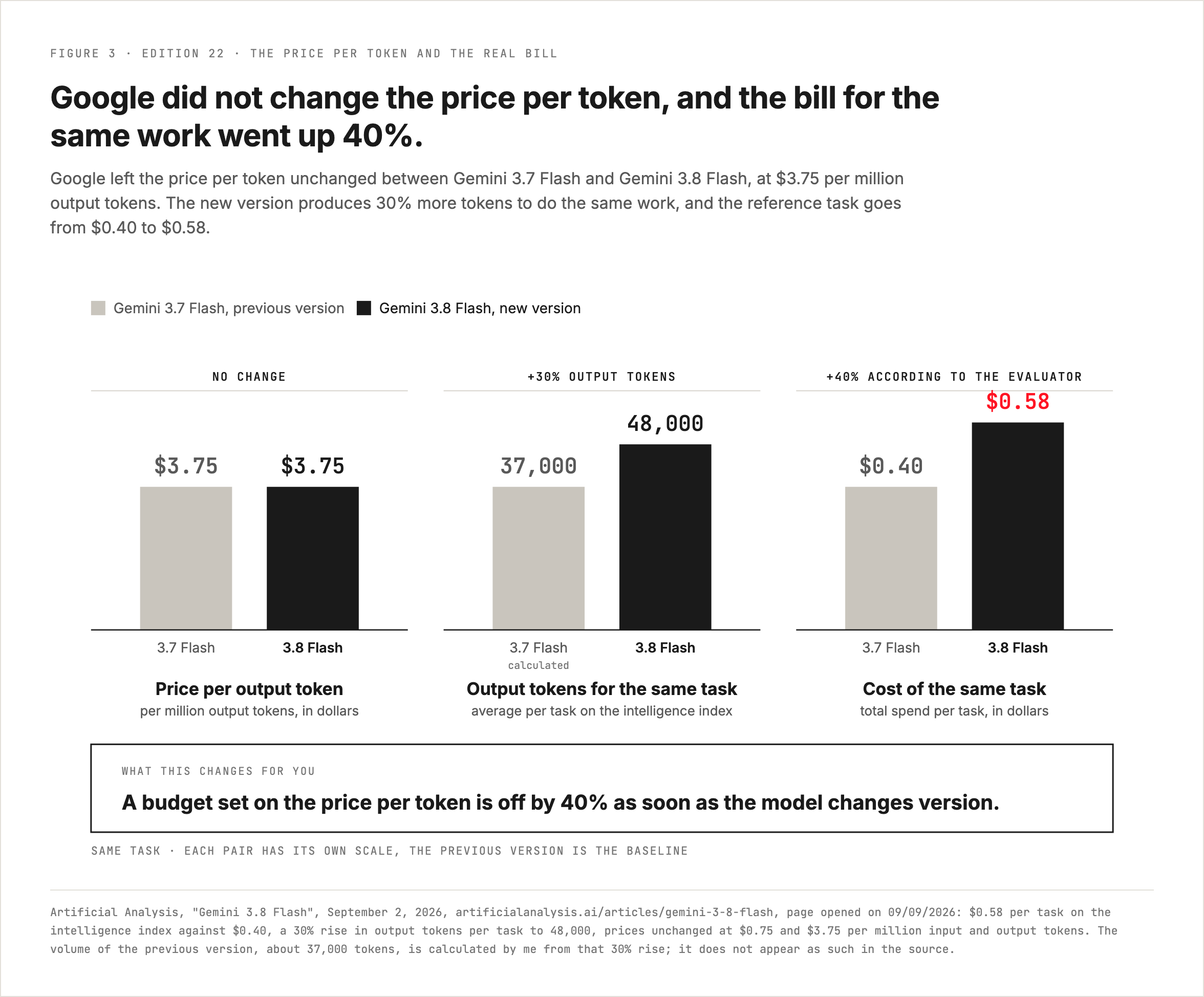
7. Google kept the same price per token, and the same task costs 40% more on its new model. 
This fact appears in no press release; it is read in a rate card.
Google released Gemini 3.8 Flash, the new version of its fast model, at a token price strictly identical to that of Gemini 3.7 Flash. In use, the same task comes out 40% more expensive according to the evaluator ($0.58 against $0.40, that is 45% in direct calculation, which the evaluator rounds), measured by Artificial Analysis on September 2 on its test battery. The evaluator notes that the new model produces 30% more tokens per task, 48,000 on average; the rest of the gap lies in what it reads and rereads, which the measurement does not detail.

The unit price has not moved. The bill has. The same mechanism at Anthropic, where Claude Fable 5.1 costs 20% more per task than Fable 5 ($3.76 against $3.14, same evaluator, September 1), despite a 75% cut in the price of cached reading.
Add the thresholds. Beyond 272,000 tokens in a single request, that is roughly 200,000 words of English (fewer in French, which consumes more tokens), OpenAI doubles the input rate and raises the output by half, across the whole request, on its GPT-5.4 and 5.5 models; at xAI, the threshold sits at 200,000 tokens. An agent working on a distribution contract or an atelier specification crosses that threshold without anyone having warned it.
This is not a marginal phenomenon. The firm IDC, in a survey conducted in July among companies that run agents (the number of respondents is not published, and I flag it), measures an average spend of $117,558 per month: 67% of them exceeded their budget by more than 10% over twelve months, and 43.1% of those that exceed it compensate by cutting their headcount.
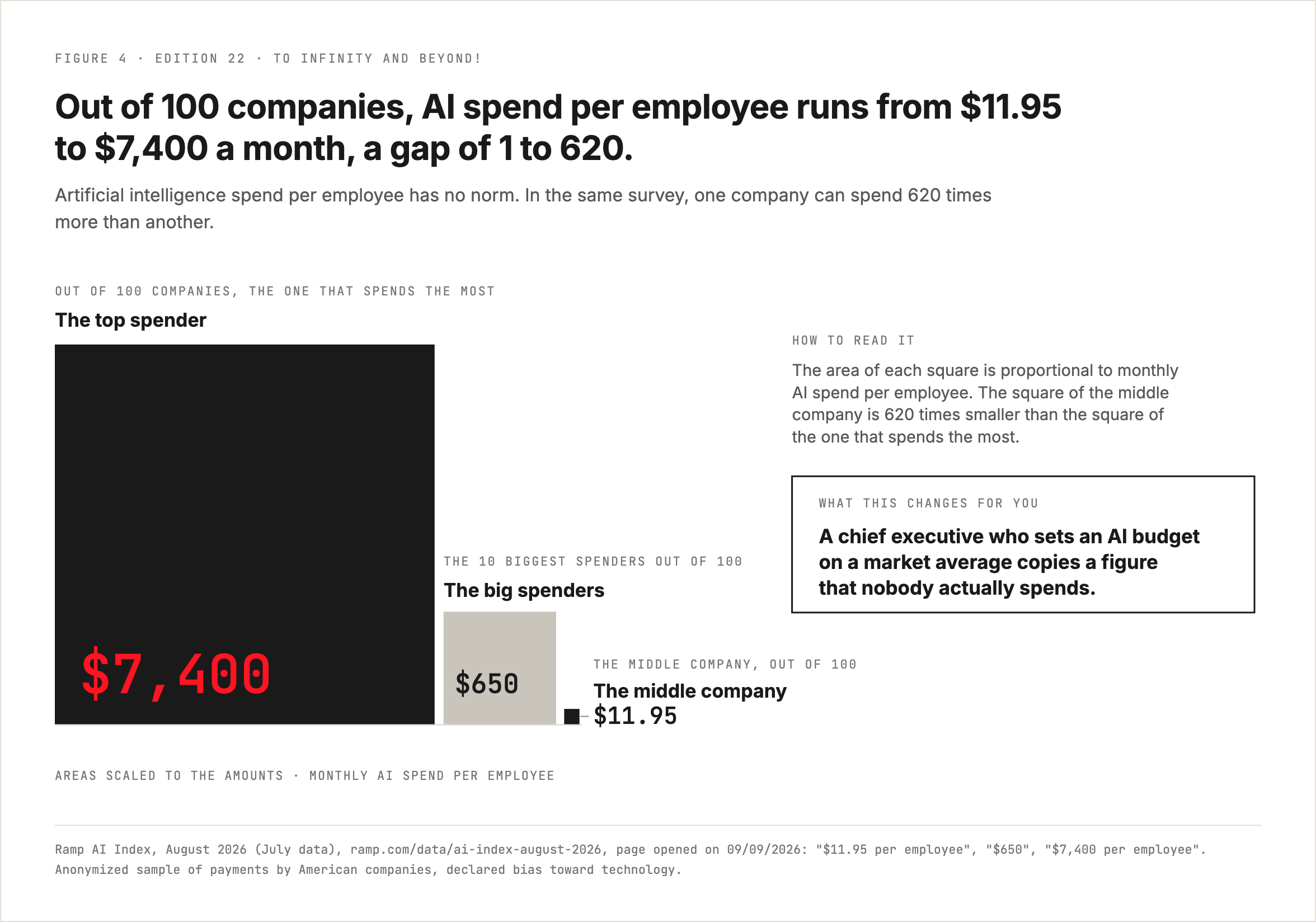
Three other measurements point the same way. Ramp, which observes the actual spending of American companies from their payments, records for July a gap of 1 to 620 between the middle company out of 100 ($11.95 of artificial intelligence per employee per month) and the one that spends the most ($7,400). Gartner forecasts that the cost of running an agent will be multiplied by more than 5 by 2028. And the platform G2 publishes its bill: $1.27 million of tokens in 2026, that is 970 billion tokens consumed.

Will Sommer, senior director analyst at Gartner, says why falling prices will save no one: "Product leaders cannot rely on more efficient token economics to rationalize AI costs. Each successive generation of AI capability will necessitate more, and often more expensive, tokens."
What a finance department does with this. The rate per million tokens no longer says what an agent costs. The only figure defensible in committee is the cost of a completed task, measured on the Maison's own documents, at the hour of the day when it will actually be launched, since the rate doubles in the morning at some vendors. Ask your provider for that figure before any quote; if they do not have it, they do not know your bill.
8. Since August 31, an employee on Microsoft Copilot can see what is left of their AI credits for the month. 
The corollary arrived in August, and it is more interesting than the question of price. On August 31, Microsoft shipped in Copilot a command, /cost, which shows the employee the percentage of their monthly credit cap remaining, what they have consumed since the start of the month, and the date on which the meter resets. On August 11, Google had shipped monthly spending caps and budget alerts on its usage-based edition. HubSpot, as I said at the outset, bills the act accomplished by the machine, and nothing when a human takes back the wheel. Three ways of moving the spend down to the workstation.
Until now, a company decided its software spend once a year, in committee, on a contract negotiated by a director. It now decides it hundreds of times a day, through people who have never been given any budget authority.
What this changes for a Maison. It is a management question before being an IT question. A salesperson who knows they have 12% of their credits left makes a trade-off, and they will make it in the direction of economy, therefore against service, without anyone knowing it. The instruction I would give a store director fits in one line: the command is not typed in front of a client, it is read in the evening.
9. On September 3, the president of OpenAI declared the era of artificial general intelligence open. 
That same day, OpenAI was presenting its most powerful model. At the end of the press briefing, Greg Brockman, the company's co-founder and president (the chief executive is Sam Altman), closed with 5 words: "Welcome to the AGI era."
AGI, for artificial general intelligence, designates, in the definition OpenAI itself has given since its founding, a system that surpasses the human on most work of economic value. It is the objective the company set itself at its creation, and that none of its leaders had declared reached.
Asked about that threshold, Brockman answered: "For me personally, I do think we're there," while acknowledging that there is no clean-cut moment and that the shift happened more gradually than announced. The model was trained on more than 100,000 graphics processors. It scores 99.9% on ARC-AGI-3, the sector's reference reasoning test, but under the test conditions set by OpenAI; Artificial Analysis, an independent evaluator, places it at 53 on its own index, and The Decoder notes that the evaluations do not agree with one another.
Whether or not one subscribes to the phrase, it was spoken by the president of the leading company in the field, in front of the press, on a Thursday in September. Your suppliers will now sell under that word; it is the spec sheet, not the word, that has to be read.
What this opens up for a Maison. Leave the phrase aside, look at the spec sheet. The model reads 922,000 tokens in one go, roughly 700,000 words of English: the entirety of a Maison's distribution contracts, forty years of press clippings or the complete specification of an atelier, read in a single pass, with no splitting and no intermediate summary. Until now, these programs were given extracts. They can now be given the file, with one reservation every user of these tools knows: the quality of the reading falls as the document gets longer, and the vendor publishes only its own measurements on this point.
The objection comes from the delivery schedule. OpenAI shipped it first to the cybersecurity players, precisely because it knows how to find vulnerabilities. A Maison will get access after those who might attack it, and after those who defend it. That is not a reason to worry; it is a reason to call your head of information security before your marketing director.
10. Salesforce commits to taking a stake in Brunello Cucinelli's platform, and a competitor becomes your supplier. 
Everything above comes from software vendors. This last piece of news comes from a Maison, and it extends a story I told you in April.
In #8, I described Callimacus to you, Brunello Cucinelli's site with no pages, no menus, no filters, where agents read the visitor's intent and compose the display for that visitor alone. The platform's site says it in one sentence: "Your website composes itself around whoever arrives." And it names its agents the way one names a crew: Socrates, Demosthenes, Dioscuri, Phantom, Thamyr. Greek names for an Italian machine. I asked a question then: how many Maisons have the means to build such an infrastructure rather than rent it from Shopify or from Salesforce? I answered around ten, and I added that the others would have to choose their dependency.
The answer came on July 27, and it is not the one I expected. Salesforce, the American giant of customer relationship software, has committed to taking a stake in Solomei AI, the company created by Brunello Cucinelli's family holding, distinct from the Maison, to publish Callimacus, with a stated purpose: strengthening engineering and research, accelerating the product, and rolling out commercial activity in Europe and North America.
In other words, selling it to the other brands: the platform already displays its connections to Shopify, Salesforce B2C Commerce and Adobe Commerce, that is, to the three online selling foundations your teams probably already use. The dependency I announced in April now has a supplier, and that supplier is a peer.
What Brunello Cucinelli, chairman of Solomei AI, says about the platform's genesis: "Three years ago, Marc Benioff and I began an endeavor with mathematicians, philosophers, humanists, and technologists, from which Callimacus was born." A philosopher on a product team. And Marc Benioff, chairman and chief executive of Salesforce, in return: "Brunello has always believed that technology should elevate humanity, and that conviction is at the heart of Callimacus."
To elevate is the verb I have been defending in these pages since February, the one that distinguishes a Maison from a brand. That it comes out of the mouth of the head of the world's leading vendor of sales software reads in two ways, and l'œil du Luxe has to hold both: a recognition, and a capture. The word is ours before being his; a vendor that takes it up turns it into a sales argument. It falls to the Maison to verify, in the product, what the word promises.
The reservations stand in full. The amount is not public. The deal awaits the authorization of the Italian Presidency of the Council of Ministers under the golden power, the veto a state exercises over foreign investments in the companies it deems strategic: it is therefore not closed. And since April, no sales figure has been published; the only result remains a doubled visit time, with no period and no measurement base. A platform proven on a single site is not a proven platform.
What this imposes on a Maison. The question is no longer whether you will build a site of this kind. It is whether you will accept that a competitor supplies it to you, with an American vendor on its cap table, or whether you prefer Salesforce's own version. Ask your executive committee whether your site has fixed pages by decision or by inheritance from 2015. If no one can answer, Cucinelli has just got ahead of you on a decision you had never taken.
My read of the week: the OpenAI study that weakens OpenAI's sales argument. 
"How organizations use ChatGPT," OpenAI, August 11, 2026.
OpenAI published this summer a study on the way companies use its product. No one would have noticed it if a Fortune journalist, Emily Forlini, had not gone and read the appendices. What she found there, on August 13: the study brings out no correlation between the quantity of artificial intelligence a company consumes and its revenue per employee.
The world's leading seller of artificial intelligence itself publishes the document that establishes that consuming more of its product does not make you earn more money. Not yet, not mechanically, not through the volume of use alone.
What I do with it. It is the most solid argument a finance director can set against a budget request, and it comes from the supplier. It requires changing the way a project is framed: stop measuring adoption by volume (number of employees equipped, number of requests launched) and measure it on a business result named in advance, as one does for a media plan.
The objection, which I address to myself. An absence of correlation in a cross-sectional study is not proof of an absence of effect, above all when the revenue is measured before the usage. And in Luxury, the effect of an agent will be read first on the conversion rate and on the quality of service, not on an accounting ratio.
Read it anyway. A company that publishes what weakens its own sales pitch deserves to be read.
What I take from this new season, and where l'œil du Luxe stops. 
Three things learned in eight weeks by this software, a price divided by 25, €3 billion raised in Paris with European law in the contract, a bill going up at constant list price, and a cashmere Maison that has put a philosopher on its engineering team.
I proposed that you read all of this with l'œil du Luxe, the one that recognizes a right gesture because it knows its price. I owe you now the strongest objection against my own thesis. That eye is trained to judge what is seen and touched: a material, a finish, a proportion, a silence in a sale. Yet nothing that counts in this letter can be seen. The quality of a voice in duplex, the soundness of processing in Europe, the real cost of a task: all of that is read in a rate card, a contract clause, a time window.
And that eye has already been wrong twice in front of technology: at the beginning of online commerce, when it judged the aesthetics of the sites and neglected logistics and returns; in 2021, when it recognized excellence in digital objects of which almost nothing remained eighteen months later.
The full thesis is therefore this one. L'œil du Luxe is necessary to recognize a gesture; it is insufficient to judge a system. A Maison that wants to choose its agents has to keep the first and acquire the second: to learn to read the two lines at the bottom of the contract with the same rigor it brings to judging a seam.
It is an obligation, not a piece of advice. A trade that has spent two centuries charging the price of a right gesture cannot buy its tools on the strength of a demonstration.
Luxe oblige !
Michaël Tsakiris
Paris, Thursday 10 September 2026