
"Ready-to-Wear, Ready-to-Ware" carries ready-to-wear over to software: ware bought off the rack, an agent designed once by the vendor and delivered identically to every Maison, competitors included, inside the tool their teams open every morning. Edition 21 showed that route for email and IT access; today it reaches the trade that creates the pieces.
"These agents do not arrive through a project of the Maison, they arrive through the catalogue of the vendors whose software it already uses."
Welcome to LUXE ÆTERNAI, my weekly decoding of what AI agents change, or don't, for Luxury Maisons. I am Michaël Tsakiris. I help leaders and executive committees in Luxury and premium decide what they entrust to agents, and I put it in place with them until their teams run it themselves. Enjoy!
The LUXE ÆTERNAI connector. It is a bridge between this letter and your AI assistant. Once it is added, your assistant no longer answers from memory on these subjects: it searches every published edition and the document base, reads an entire edition, and can pass your question on to me. To install it, add the address https://connecteur.luxeaeternai.com/mcp to your assistant's custom connectors (ChatGPT in developer mode, Claude, Mistral, depending on your plan). It reads only public content: send nothing confidential through it, and have it installed on an account approved by your IT department (privacy policy).
The week in short 
The thesis. Ready-to-Ware: the product development agent arrives through the vendors' catalogue, delivered identically to every Maison and, according to FashionNetwork, billed at Lectra per product development. The Maison does not choose the agent, it chooses its terms: when it buys or activates the module, or when the contract renews.
The paradox. A Maison sells gesture, material and time; in its offices, it rewards speed. Measure judgment, not hours.
What's moving. Accor plugs into three assistants, according to Skift; at Sabre, 4 or 5 partners out of 60 run an agent in production.
The three that count, outside Luxury. Adecco equips 27,000 employees with an agentic assistant, OpenAI slips the brand agent into ChatGPT advertising, TotalEnergies and Mistral put a figure of over €100 million on dedicated models.
The story. Muse, Meta's agent, buys with its user's approval and under the watch of a second agent, Sentinel, never with the Maison's. If the purchase goes wrong, the guarantee of Link, the payment service it uses, refunds no more than $1,000 per claim: a Haute Maroquinerie bag is not covered.
The radar. HubSpot updates the client file from a meeting, Google plugs Gemini into third-party tools by default, Cohesity promises to roll an agent back to a healthy state.
My indiscreet question. How many product developments does your Maison launch each season, category by category, and how many are only technical variants?
Bêta Luxury. The site that recognizes the agent a client sends, tells it apart from the crawler training a model, and sets access according to the declared use.
In my reading list. Gartner, a booking agent that obeys a single sentence, 1,919 candidates facing automated screening, and the noise in judgment according to Kahneman.
Coming next. Fine wine and AI in London on the 23rd, Paris Fashion Week from the 28th, the close of EMVCo's consultation on agent-initiated payments on the 30th.
A Maison sells gesture, material and time; in its offices, it rewards speed. 
A Luxury piece sells with the atelier hours it holds, and with a material, a design, a name. In the offices of those same Maisons, Carlota Rodben, a specialist in Luxury innovation, observes another scale: speed becomes the criterion on which an employee is judged.
In Jing Daily, on September 12, she writes that Luxury "sells effort as proof of value", and that effort is precisely what AI is best at shortening. Her first question to leaders: do we assess the time spent, or the judgment applied? I add my own. When the product development agent delivers, in an hour, directions that look finished, who decides that they are not?
"sells effort as proof of value"
"Measure judgment, not hours."
The Harvard Business Review of September 16 asks us to picture a photographer facing a campaign image already approved, lit as no studio knows how to light: it will have to be reshot with actors. Behind the scene sits a study published in April in Academy of Management Discoveries: a year of observation in the creative department of RTL Nederland and 207 Midjourney images analyzed by Jana Retkowsky, Ella Hafermalz and Marleen Huysman. The image looks finished, the client grows attached to it, exploration closes too early. A product development agent will do the same with a 3D prototype.
The paradox resolves in what the Maison measures. Counting hours saved rewards the image that closes down creation. Three measures replace them: the number of directions actually explored, the date in the season on which the creative decision is locked, the gap between two collection directors scoring the same proposals. The tool delivered identically to every Maison knows how to count speed. Judgment is not in the catalogue.
What I take from this.Remove time saved from the annual objectives of the technical design office, after informing and consulting the works council. Present the discarded directions to the collection committee, with the reason for each rejection. Try the agent on a capsule before extending it to the season.
Sources for this section3 links
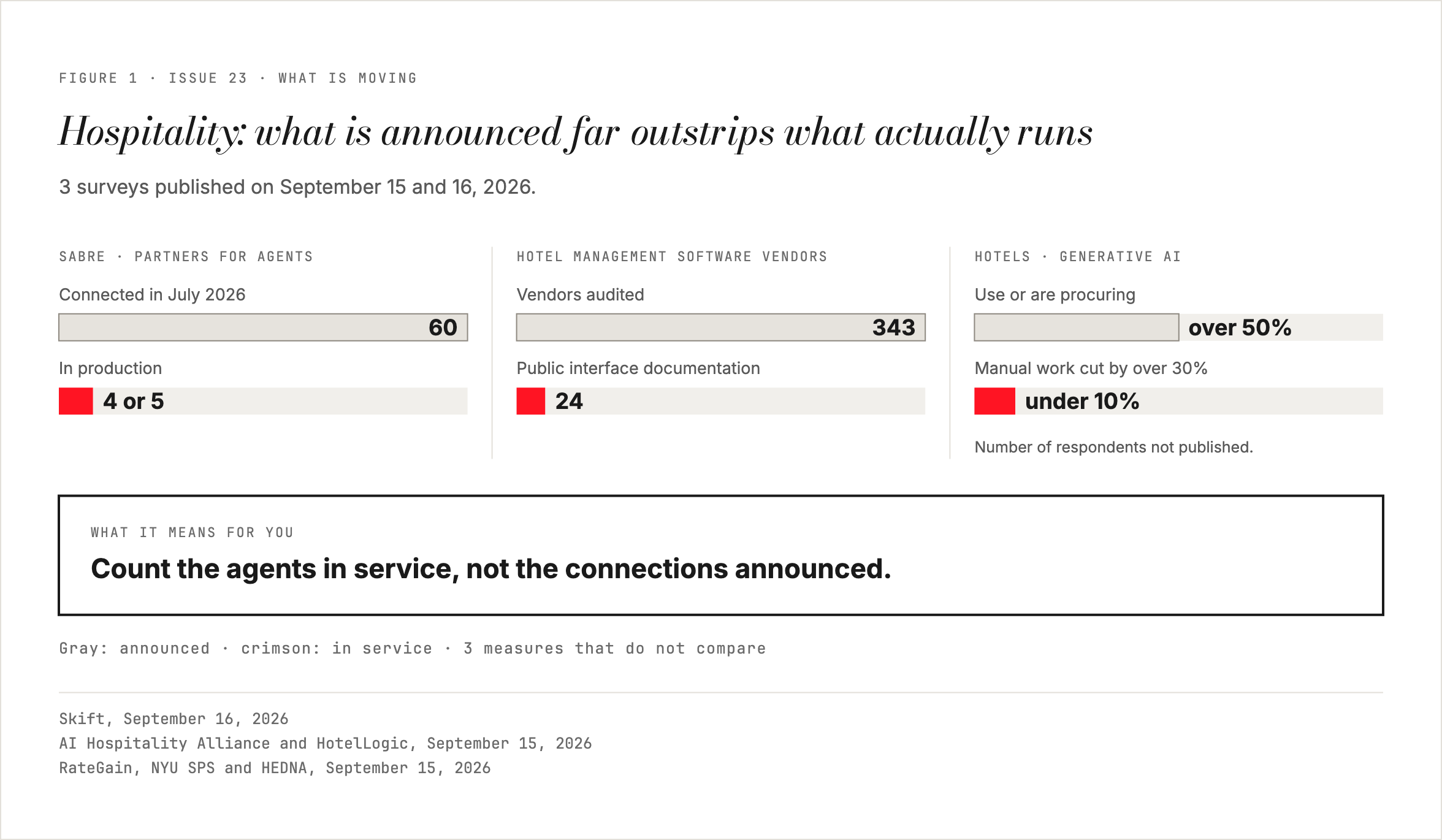
Accor plugs into three assistants, according to Skift; hospitality counts what runs. 
Skift notes three Accor connections. According to its Power Rankings of September 16, Accor (Raffles, Orient Express) has an app already live in ChatGPT, which it had announced itself (Accor, Hotel Management), an integration in service with Anthropic through MCP, the protocol that connects an agent to a tool, and is preparing Google's commerce protocol (UCP) for the next six months. I have found no Accor press release on the other two: Skift's profile is fed by the group itself.
Hospitality counts what runs. At Sabre, the partners connected to its agent interfaces went from 30 to 60 between June and July. In production: "four or five", says Garry Wiseman, president of product and engineering, in the same ranking. Skift does not date that count. I read it as a ramp-up, not a failure.
4 or 5out of 60 partners
Skift, Power Rankings, September 16, 2026 · count not dated
Two other surveys, of a different kind. Of 343 hotel management software vendors audited by the AI Hospitality Alliance and HotelLogic, 24, or 7%, publish in open access the documentation an agent needs to connect (Hotel News Resource, September 15); four vendors funded the distribution of the study. According to the report by RateGain, New York University and HEDNA (Hotel Electronic Distribution Network Association), fewer than one hotel in ten says it has cut its manual work by more than 30% (Hospitality Net). Base: data covering more than 58,000 properties, number of respondents not published. Neither isolates the high end.
24vendors out of 343
AI Hospitality Alliance and HotelLogic, September 15, 2026 · study funded by four vendors

For a Maison, the inventory falls to the IT department: which point-of-sale, inventory and client file systems an agent can call, and which have no documented interface. Without an interface, the agent does not give up: it goes through the web page, more slowly, less reliably, and outside the Maison's control. What an agent cannot call, it works around.
Sources for this section5 links
Outside Luxury, the agentic week in three facts. 
1. Adecco puts an agentic assistant into the daily work of 27,000 employees. On September 15, Adecco announced it is rolling out Agentforce Coworker, Salesforce's agentic assistant, to 27,000 employees in more than 40 countries. Its recruitment agents take on screening, hiring or onboarding for a profile chosen by the recruiter (PR Newswire). Why it counts: a Maison that recruits its seasonal staff through a temp agency group may see its candidates screened by these agents. That is a use the European AI Act classes as high risk, with obligations applicable on December 2, 2027 according to the European Commission. The temp contract gets reread now: who reviews, who keeps the trace, who answers in a dispute.
27,000employees
Adecco Group, September 15, 2026
2. OpenAI slips the brand agent into advertising. On September 16, OpenAI presented "Sponsored Agents", in testing with selected advertisers in the United States: after clicking an ad in ChatGPT, the user talks with the brand's agent in "a clearly labeled conversation", and the advertiser can let the AI rewrite its headlines at every exchange (The Next Web, PYMNTS). Why it counts: a headline rewritten on the fly is a text no brand department has reviewed. A Maison keeps rewriting switched off, has its headlines reviewed market by market and writes the forbidden wordings into the contract.
3. TotalEnergies and Mistral put a figure on dedicated models: over €100 million across three years. The joint program of September 15 funds a laboratory and proprietary models for oil exploration, according to the press release, picked up by World Oil and Rigzone, without each party's share. These are models, on which the group's engineering agents will come to rely. Why it counts: "proprietary" here means trained on the data of a single industrial company; when a vendor says the same word to a Maison about a module delivered to all its clients, it is not talking about the same thing.
Sources for this section9 links
Product development joins the agents' ground through the door of the software already in place: what the Maison decides before activating. 
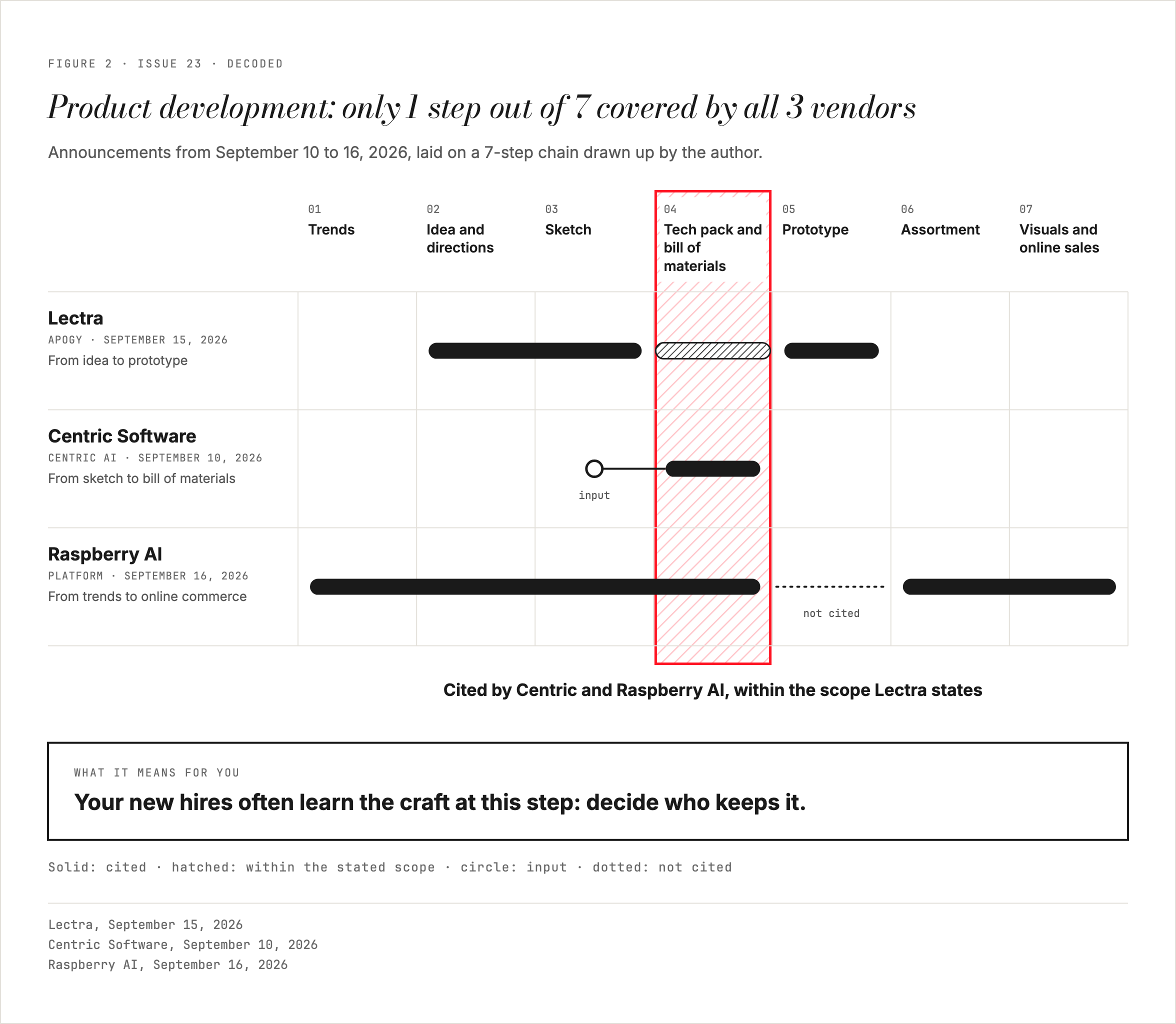
The Lectra press release presents Apogy as an online workshop: agents follow a piece there from the first intention to the prototype the factory can produce, and keep the history of every alteration. Around thirty companies have tested it, according to FashionNetwork. The clients named are outside Luxury: O'Neills and Oniverse (Calzedonia, Intimissimi) in the press release, the contract manufacturer Siena in front of Just Style.
Centric Software, whose software lists Luxury among its sectors, shows a tech pack agent that can "turn a rough sketch or supplier document into a complete, multi-line bill of materials in minutes", according to its press release of September 10. It is the vendor that speaks of an agent: I have found no client confirming it.
Raspberry AI promises an entire collection from a single prompt, while keeping people "in control at every stage". Its press release names Oscar de la Renta among seventeen brands, without describing the use. Of the seven steps I distinguish between the trend and online sales, only one is covered by all three: the tech pack and its bill of materials, cited by Centric and Raspberry AI, and within the scope Lectra states.

No project to launch.
Lectra and Centric already sell their software to fashion and to Luxury: the agent arrives inside the tool the teams open every morning. The decision is made when the module is bought or activated, or when the contract renews. Those are the only moments when the Maison sets its terms.
An invoice for every product development.
Lectra is paid by the number of product developments carried out with its tools, and not by the number of their users, according to FashionNetwork, the only source I have found on this point. Per-act billing, which appeared in customer service (edition 22), is reaching design, and Luxury has to read it the other way round: a vendor paid per product development has an interest in volume, the Maison in scarcity. The agent is the same for all, the meter runs at each.
An abandoned prototype fills no warehouse. The risk comes afterwards: more product developments mean more references proposed to merchandising, scattered material purchases, more references put into production. At the end of the chain lies unsold stock, which the European ecodesign regulation has forbidden large companies to destroy since July 2026 for apparel, clothing accessories and footwear.
Promises. Lectra projects 30% less product development time in Luxury and 2 to 3 times more products in fashion, without citing a study (FashionNetwork). Centric announces 90 to 98% of data entry and bill of materials time recovered. Cheryl Liu, founder of Raspberry AI, promises a finished collection "in days, not seasons" (press release). The strongest objection: these vendors already equip the ateliers and know the trade. It half holds. I have found neither the number of clients measured, nor the share of the gains obtained on a runway jacket rather than on a basic T-shirt.
"in days, not seasons"
"The agent is the same for all, the meter runs at each."
The specialists' bet. The vendors' choice matches a forecast by Gartner, published on September 10: by 2028, 80% of the tangible return on investment from agentic AI would come from specialized agents built for one trade, and not from generalist agents; the value would come from agents that carry out a task within a process, not from those that suggest. Lectra, Centric and Raspberry AI are making exactly that bet on a single trade, product development. Two reservations: it is a consultancy's forecast, not a measurement, and the 107 deployments Gartner analyzed are neither listed nor tied to a sector.
80%of the return on investment
Gartner, September 10, 2026 · a forecast, not a measurement
What a Maison decides before activating. The scope, first. The technical variant (supplier replaced, bill of materials redone, size grading) goes to the agent from the first season. The creative variant (a colorway, a material to qualify with a supplier), the special order and the exclusive piece stay with the studio. No bill of materials from the agent goes to purchasing without the validation of a named person.
The contract, next. The billing unit, the product development, is defined by the Maison, variants carry a separate rate, the price is degressive or capped per season. Three indicators are written down before the negotiation: the lead time from approved sketch to accepted prototype, the share of product developments carried out by the agent, the full cost of a product development that reaches the boutique.
Ownership, finally. I have found in none of the three press releases what becomes of the patterns, sketches and bills of materials the agent reads. Hence the 5 Ready-to-Ware clauses, to demand before activating:
To demand before activating 
- 1.No creative data trains a model delivered to competitors.
- 2.The agent's output belongs to the Maison, with the trace of human intervention, a necessary condition for claiming protection.
- 3.The vendor indemnifies if a generated direction reproduces a protected design.
- 4.The data stays in a place the Maison knows.
- 5.The history of alterations can be exported at the end of the contract.
Then there is apprenticeship. Jean Lave and Étienne Wenger showed in Situated Learning (Cambridge University Press, 1991) that one enters a trade through its secondary tasks, the invisible work that makes visible work possible, in the words of Susan Leigh Star and Anselm Strauss (1999). The variants and tech packs the agent takes over are often that way in. The Lectra press release promises to reduce "dependence on a few experts" (translated from the French): depending less on pattern makers does not license doing without them. The agent takes the series, the beginner keeps the technical design office.
When every Maison receives the same agent, each keeps its data, if the contract keeps it for them, its settings and its judgment. Ready-to-wear software moves the gap between Maisons: it is no longer in the tool, it is in what they do with it.
What I take from this.On Monday, one thing only: reread the contract for the product development software and note its renewal date. Next, have the studio and purchasing write the definition of a product development, together. Demand the 5 clauses before any activation, after informing and consulting the works council. Each season, give newcomers product developments the agent does not touch.
Muse, Meta's agent, buys in its client's place; if the purchase goes wrong, the payment guarantee covers no more than $1,000. 
Second on the US App Store, 338th in the productivity category on Android: that is the ranking of Muse, Meta's personal agent, noted by TechCrunch on September 10. The launch predates our last edition: I take it as context. The week brings the first trials and the first reservations.
That same September 10, L'Usine Digitale details what Meta has opened to American adults. Muse books a trip, fills in a form, haggles over a price, from a dedicated computer in the cloud. It neither pays nor writes an email without its user's go-ahead. On trial, The Verge saw validation concentrate on the purchase.
Muse does not work alone. According to the engineering post Meta published at launch, which I cite as context, a second agent, Sentinel, is the only authority that approves an outgoing action. It is one layer among others against booby-trapped pages, which Meta does not claim to have beaten: "Prompt injection remains an open problem in the industry." L'Usine Digitale asks: by stacking a control agent, human validations and limited-use cards, how far is anything really automated? For a Maison, the stake lies elsewhere. Its client sends it an agent watched by another agent, and the Maison chooses neither.
"Prompt injection remains an open problem in the industry."
Then there is trust. According to Search Engine Journal, reading that same post on September 15, the agent's browsing appears as the user's own, which the site visited can then target on Instagram. Will a Haute Joaillerie client open her inbox to Meta?
I read Muse as an after-sales test before seeing it as a sales test. Payment goes through Link, Stripe's wallet, which covers eligible purchases: item damaged or lost, price drop, free return. For a Maison that holds no sales, or few, the price drop matters little, the return a great deal. And that guarantee is short. According to Link's help page, read on September 17, no protection exceeds $1,000 per claim: $500 for an item damaged, lost or stolen, $250 for a free return. A Haute Maroquinerie bag is not covered.
1,000dollars
Link, help page read on September 17, 2026 · a Haute Maroquinerie bag is not covered
"The Maison keeps the sale and loses the relationship."
The agent orders with its user's approval, never with the Maison's. At Shopify, eligible American merchants are enrolled by default, and it is up to them to opt out, according to Vogue Business of September 10. The same article, citing the Financial Times, adds that Muse can, with permission, read its user's private Instagram and Facebook messages.
If the order does not arrive with an identified, consenting client in the file, the Maison keeps the sale and loses the relationship. The Instagram message in which a client advisor follows up with a client becomes readable by her agent, if she allows it. Reread your return conditions and your messaging charter the way an agent will read them: line by line.
What I take from this.Prepare customer service's answer to a claim Link does not cover. Require the commerce platform to attach every order placed by an agent to the client's record, with her consent. If your US store runs on Shopify, decide who, in the digital department, keeps or switches off default enrollment.
Sources for this section8 links
What your teams' tools are learning to do this week. 
Marketing and client relations · September 16, HubSpot.
Deal Progression updates the customer relationship management tool from a meeting transcript, "all with one click approval" (post): every meeting with a distributor becomes an entry in the file.
Office software · September 15, Google Workspace.
Gemini connects to third-party sales, project and accounting tools from Docs, Sheets and Slides, a setting on by default: switch it off before a team plugs the client file into it.
IT and security · September 16, Cohesity.
Agent Resilience rolls an agent back to a healthy state after corruption, an error or an attack; what it has already done elsewhere, an email sent, an order placed, stays done. Amazon Bedrock only, a few clients, general availability targeted for late 2026 (press release, SiliconANGLE).
Sources for this section4 links
How many product developments does your Maison launch each season, category by category? 
Put the question to your head of product development, then to purchasing, and demand the answer by category: ready-to-wear, leather goods and accessories, shoes, jewelry. A total says nothing. Ready-to-wear renews most of its styles every collection; leather goods live on permanent lines declined in colorways and materials; jewelry develops few pieces, on long cycles, where almost every step engages creation.
For each category, three figures: the product developments launched last season; those that reached a boutique; those that were only a technical variant of an existing style (supplier replaced, bill of materials redone, size grading). The first gives the team's workload. The gap between the first and the second, the work that never serves. The third, what an agent could take on without touching creation: probably a real share in leather goods, almost nothing in jewelry.
| Category | Product developments launched last season | Those that reached a boutique | Those that were only a technical variant |
|---|---|---|---|
| Ready-to-wear | |||
| Leather goods and accessories | |||
| Shoes | |||
| Jewelry |
Scroll the table horizontally.
Then multiply, category by category, by the price of a product development written into your contract: I have found no public rate card. The vendor will count your product developments to bill you for them; no one, at your Maison, counts them yet to decide.
It is the starting point of the Agentic Delegation Plan: for each trade in the Maison, the tasks it delegates to an agent and those it keeps for itself, costed, with the clauses and the indicators written down before the contract renews.
The site that reads the agent's declared use before answering it. 
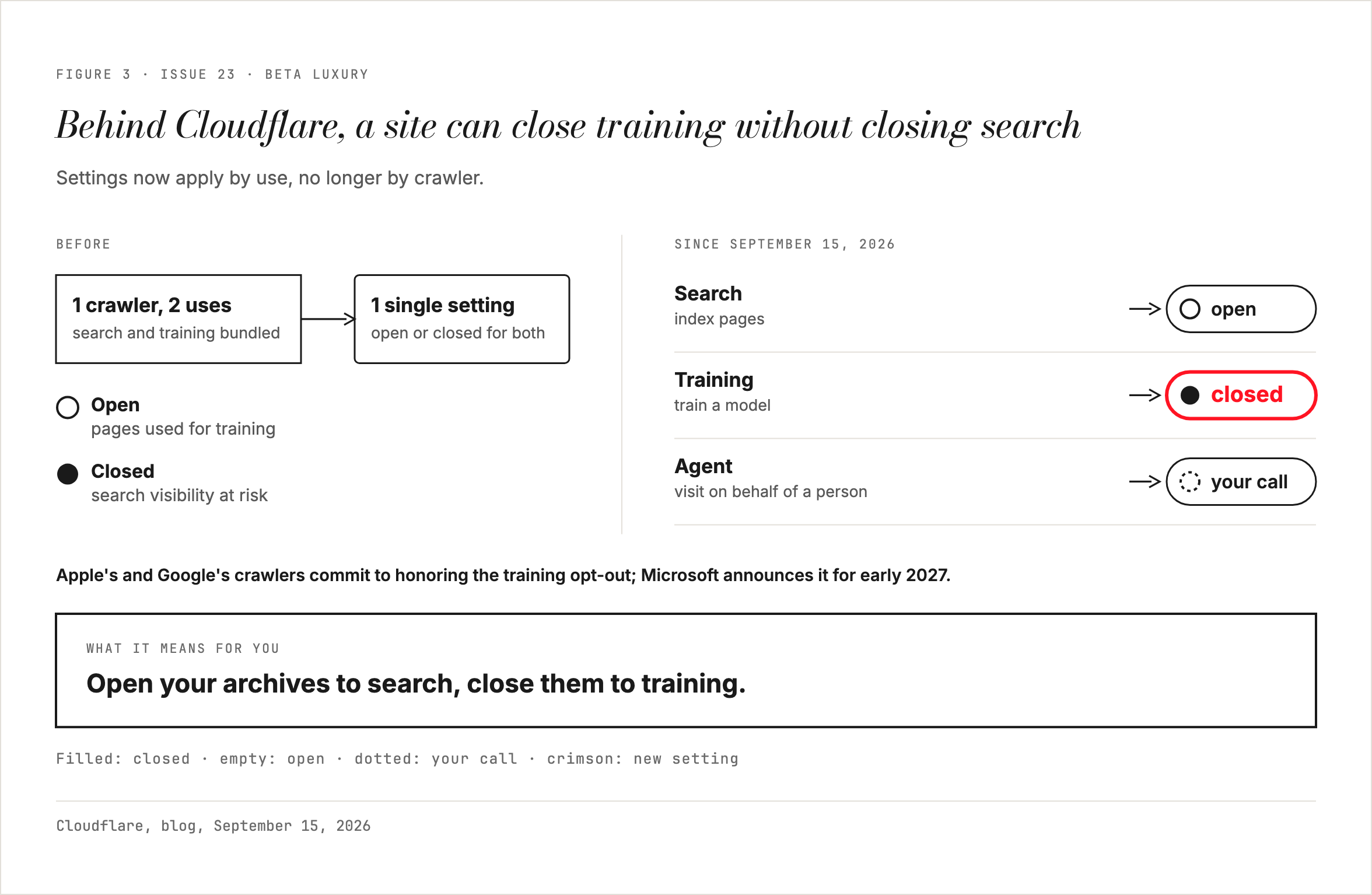
A Maison's site used to receive two visitors, the human and the crawler. It has received a third since agents like Muse started ordering for someone: the one that comes on a client's behalf, declares what for, and leaves with a receipt.
On September 15, Cloudflare enabled the sites it protects to treat separately the search index, the training of a model, and "user-directed agents visiting a page on behalf of a human". The same day, the IETF, the body that sets the Internet's technical standards, adopted a first draft of an identity framework for agents, co-written notably by Amazon Web Services and Okta. It comes from its WIMSE working group (Workload Identity in Multi-System Environments, the identity of programs across systems).
A researcher, Rajarshi Chowdhury, published terms.txt on September 10: the site writes in it what an agent may read and for what purpose, and the agent leaves with proof of what it took, on whose behalf.

Agent identity was in edition 16, the crawler toll in edition 19. What is new is the declared use and the receipt that proves it. In the European Union, a machine-readable reservation already counts as an opt-out from text and data mining, under the 2019 copyright directive, and providers of general-purpose models have had to respect it since August 2025 (AI Act). The right ground for a Maison: the license for its images, archives and campaign visuals, open to the press or to teaching, closed to training.
"Its archives are worth more than its product pages."
A reservation protects only if it is written, dated and machine-readable: Cloudflare's setting enforces it, it does not replace it. Without one, a campaign archive can train the model that will design a competitor's campaign. Before opening its images under license, the Maison checks what it holds: photographers' assignments of rights, contracts with models and ambassadors. One cannot grant what one does not own.
The trap: "Accountable", the label Cloudflare grants to the mixed-use crawlers of Apple, Google and Microsoft, rests partly on promises. Apple and Google commit to honoring a training opt-out without affecting ranking; Microsoft announces it for early 2027. Terms.txt remains a single author's proposal, and I have found no adoption of it. I have found no Maison publishing an access policy by use today. By the Haute Joaillerie presentations of July 2027, I expect a jewelry Maison to be the first, because its archives are worth more than its product pages.
What I take from this.Ask the digital department for the list of crawlers and agents reading the site, sorted by use. Write an access policy by use for the archives and campaign visuals. Have it approved by the legal department before the next campaign.
Sources for this section5 links
To dig deeper. 
- Gartner, "Mastering Agentic AI: Multimillion-Dollar ROI Lessons", September 10. Six pitfalls, among them "agent washing", mistaking a simple assistant for an agent that chains actions in your systems: enough to sort through a vendor demo.
- Davood Wadi and Yu Ma, "Whom Do AI Agents Work For?", McGill University, September 16. A booking agent tested on ten Expedia hotels, 500 trials per condition: working for the traveler, it picks the sponsored listing in 2.8% of cases; working for the platform, in 25% (preprint).
- Chuyao Wang, Patrick Sturgis and Daniel de Kadt, "Do job seekers value procedure in AI hiring only for error correction?", September 14. For 1,919 American job seekers, the presence of a human in screening applications weighs more than recourse or a bias audit (preprint).
- The classic. Daniel Kahneman, Olivier Sibony and Cass R. Sunstein, Noise: A Flaw in Human Judgment (Little, Brown Spark, 2021). Professionals supposed to be interchangeable judge the same case very differently: before comparing an agent with your experts, measure how far your experts diverge from one another.
Sources for this section3 links
The agentic Luxury agenda, September 23 to 30. 
-
Wednesday 23,
4:30 p.m., London.
At The Drinks Business conference, the panel "Fine Wine Meets AI" brings together five fine wine players, among them WineFi and Wine Owners.
-
Monday 28.
Opening of Paris Fashion Week, women's ready-to-wear, spring-summer 2027, through October 6.
-
Wednesday 30.
Close of the EMVCo consultation, EMVCo being the joint technical body of the card networks, on card payments initiated by agents, open to any Maison that takes card payments.
The algorithm arrives ready-to-wear. The decision stays made to measure: a year from now, what sets a Maison apart will not be the agent it received, it will be what it counted before entrusting anything to it, its product developments, its data, its judgment. Luxe oblige !
Set aside by the agentic filter, for want of an agent that itself carries out a sequence of actions in a system: Moncler's shopping guide, which recommends and does not order; SMCP's inventory with Lokad, where the calculation proposes and the teams place the order; Alice + Olivia's virtual try-on, which is generative.
Sources for this section3 links
Michaël Tsakiris
Paris, Thursday, September 17, 2026